

Nipah virus is a significant emerging infectious disease. Although outbreaks are infrequent, the Nipah virus is deadly, characterised by a high case-fatality rate and transmission rate. That is why early awareness and prevention are highly significant in managing the infection. However, Nipah has, in recent years, been classified as a priority disease by health organisations like the World Health Organisation, as
it has the potential to cause an epidemic due to its strong epidemic potential, and lack of specific treatment is an additional concern.
This guide will discuss the severity of the Nipah virus, its impact, causes, treatment, and prevention strategies, all of which have been well supported.
What Is the Nipah Virus?
The Nipah virus (NiV) is a Zoonotic virus, transmitted by animals to humans. People can also be infected through close contact with patients. It was initially identified in 1998 when the pig farmers had an outbreak of the virus. It has since led to occasional epidemics in the South and Southeast Asian regions, especially in India and Bangladesh.
The natural vectors of the virus are the fruit bats of the Pteropus genus, also known as the flying fox. The severity of this virus has also been demonstrated by numerous real-world outbreaks. Out of the initial outbreak that occurred in 1998-1999 in Malaysia, there was an outbreak of more than 250 infections, and the majority of the infected were pig farmers having close contact with the infected pigs. To avoid the spread, the government had to slaughter over one million pigs.
Thereafter, several outbreaks were reported in Bangladesh, in which researchers found that infections were linked to individuals who consumed raw date palm sap contaminated by fruit bats. A well-known outbreak occurred in 2018 in Kerala, India, where several people died before the virus was contained by conducting high-level infection-controlling hospital operations and rapid contact-tracing. Such incidents suggest that the virus is capable of interpersonal, inter-animal, and inter-human transmission.
How Dangerous Is the Nipah Virus?
The Nipah virus is considered highly hazardous due to multiple factors. It is said to cause a high mortality rate, rapid development of symptoms and severe complications that can develop in infected persons.
1. High Fatality Rate
The fatality rate of Nipah infection is 40-75 per cent, depending on the speed at which the patients obtain support care and the management of the outbreaks.
2. Severe Complications
The respiratory system and the brain are mostly affected by the virus. Many patients develop:
- Acute encephalitis (inflammation of the brain)
- Difficulty with severe breathing.
- Neurological impairment in the survivor over the long term.
3. Rapid Disease Progression
The symptoms can progress rapidly. In some cases, a patient who initially experiences a mild fever may develop coma within a few days.
4. No Approved Cure or Vaccine
There is currently no single antiviral therapy or approved vaccine for Nipah virus infection. The scope of medical care is based on supportive treatment aimed at dealing with symptoms and complications.
5. Outbreak Potential
Nipah is a significant health problem to the human population by virtue of its ability to infect fellow human beings, especially in densely populated regions.
Nipah Virus Infection Symptoms
The symptoms usually arise 4-14 days following exposure. The symptoms are typically similar to those of other viral diseases, making them difficult to identify in the early stages.
Early Symptoms
- Fever
- Headache
- Muscle pain
- Sore throat
- Fatigue
- Vomiting
Advanced Symptoms
- Dizziness and confusion
- Drowsiness
- Seizures
- Altered consciousness
- Serious lung complications.
Critical Stage
- Encephalitis (inflammation of the brain)
- Severe instances within 24-48 hours of a coma.
Some survivors might have long-lasting neurological symptoms such as memory and personality disorders.
Causes and Transmission OF Nipah Virus
Prevention of Nipah depends on the knowledge related to its transmission. Learning about how the virus spreads helps people avoid high-risk behaviours and places. It also enables health authorities to implement early control measures to prevent further spread of outbreaks.
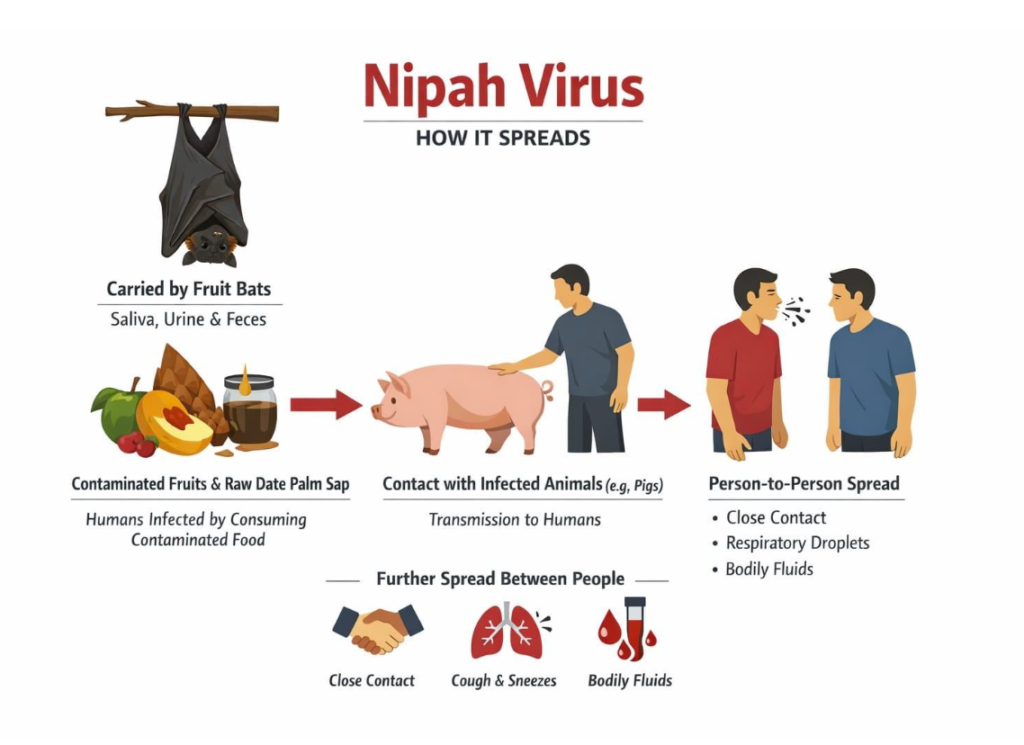
Animal-to-Human Transmission
Infection by humans can occur by way of:
- Personal contact with infected bats.
- Eating fruits polluted with the saliva or urine of bats.
- Consumption of raw date palm sap.
- Exposure to contaminated swine or pested livestock.
Human-to-Human Transmission
The virus spreads through:
- Direct physical contact with sick people.
- The person was exposed to respiratory droplets.
- Contact with bodily fluids
- Infection control in a healthcare setting.
Unless appropriate protective measures are implemented, family members and healthcare workers remain vulnerable to increasing risks.
Treatment Options for Nipah Virus
No specific antiviral medication is currently approved for the treatment of Nipah virus infection. The ectopic treatment is supportive and aimed at complication management.
Supportive Care Includes:
- Hospitalisation in the isolation unit
- Respiratory support (oxygen or ventilator)
- Intravenous fluids
- Treatment of fever and convulsions.
- Evaluating the neuromuscular performance.
Early intensive care is a significant advantage, as it improves the likelihood of survival.
Prevention Strategies
The most effective defence against the Nipah virus is prevention.
Personal Prevention
- Do not consume dropped, chosen, or half-eaten medicines.
- Fruits should be rinsed with plenty of clean water.
- Do not drink raw date palm sap
- Do not get in touch with bats and ill animals.
- Wash your hands constantly.
Community-Level Prevention
- Quick detection and separation of cases.
- Contact tracking and surveillance.
- Public awareness campaigns
- Farming and handling safe practices for the animals.
Hospital Infection Control
Healthcare facilities ought to:
- Wear personal protective equipment (PPE).
- Isolate suspected cases
- Adhere to high standards of sterilisation.
- Prepare outbreak response among train staff.
When to Seek Medical Help
Attend to a person who develops:
- Tremendous headache and high fever.
- Breathing difficulty
- Lateralisation or misplaced drowsiness.
- Seizures or fainting
- Identification of outbreaks or sick individuals in the recent past.
Timely diagnosis can help save a life and prevent further growth. Experiencing breathing issues or flu-like symptoms? Consult the best pulmonologist near you today for timely diagnosis and care.
Frequently Asked Questions (FAQs)
1. How fatal is the Nipah virus?
Nipah virus is a very deadly viral disease with a fatality rate of 40- 75. Responsibility towards approaches of early medical management and favourable treatment is the key to survival.
2. What are the early symptoms of the Nipah virus?
The first symptoms presented are fever, headache, muscle pain, sore throat, fatigue and vomiting. These readily manifest themselves into severe neurological and respiratory complications.
3. How does the Nipah virus spread to human beings?
Infection takes place through contact with infected bats, contaminated fruits, raw date palm sap, infected animals and close contact with infected humans.
4. Does the Nipah virus have a cure or a prevention?
No. The approved cure is not yet in place, and neither is the vaccine. The treatment of the symptoms is founded on the supportive care provided at a hospital.
5. How do we prevent Nipah virus infection?
Prevention turns out to be the absence of contaminated food and other specifics, maintaining hygiene, having fewer contacts with infected people, and being able to see the methods of infection control in hospitals.
Our Specialities
- Orthopedics & Joint Replacement
- Robotic Knee Surgery
- Sports Injury & Arthroscopy
Our Specialities
- Orthopedics & Joint Replacement
- Robotic Knee Surgery
- Sports Injury & Arthroscopy

Author:
Dr. Pulkit Agarwal
Consultant - Pulmonology