


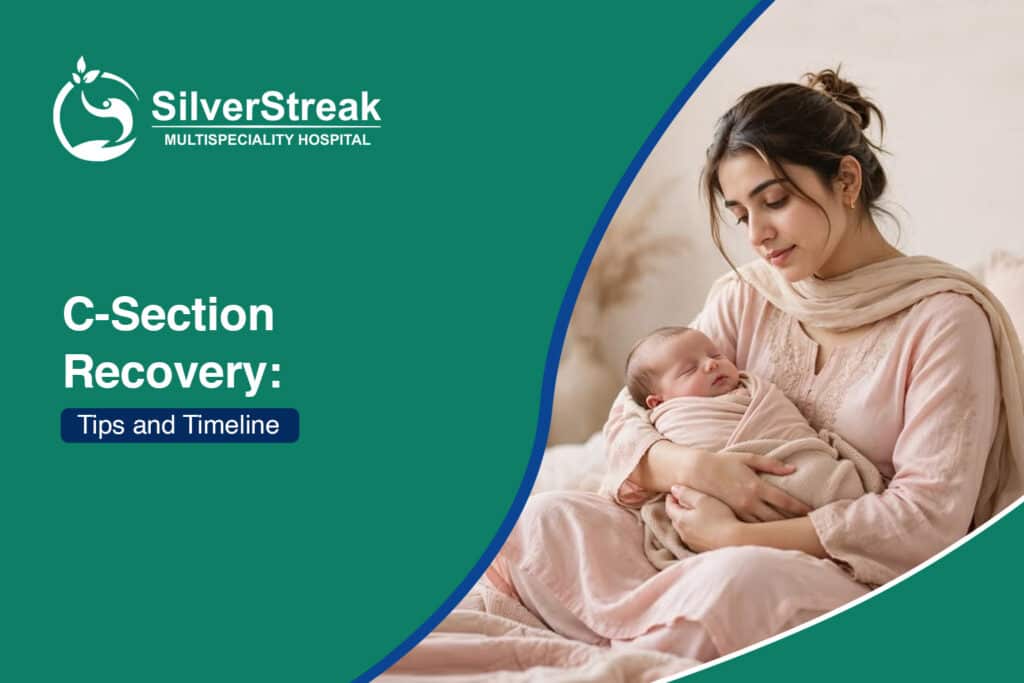
The C-section recovery time usually takes 4 to 6 weeks. By about 6 to 8 weeks after a C-section, people have recovered fully and can get back to normal activities. Besides, you might be required to remain in the hospital for several days after surgery, based on your physical state. Just remember that the healing process is individual.
Whether the operation was planned or done on an urgent basis, it helps to understand what recovery involves. This article includes the recovery timeline, practical tips, warning symptoms and how to select a gynaecologist for a C-section.
C-Section Recovery Time: What to Expect
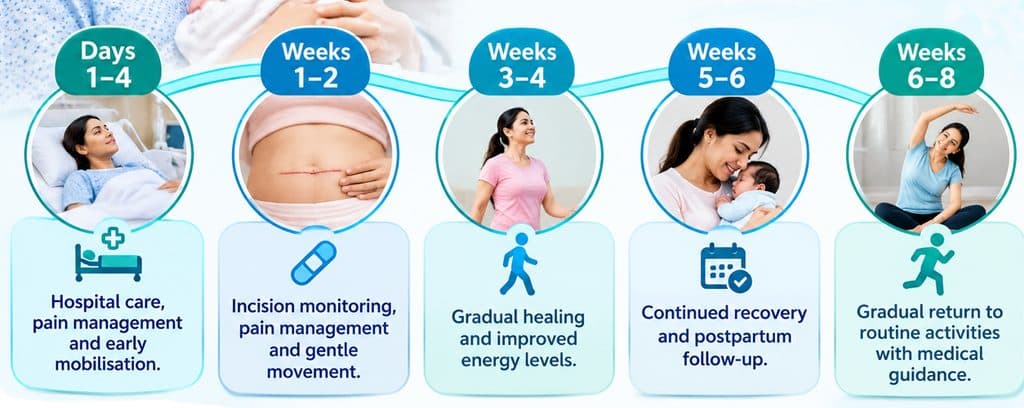
C-section is regarded as major surgery as it is done through the abdomen. The recovery is generally longer than after a vaginal birth, typically 4-6 weeks. The following chart will provide a brief outline.
| Stage | What usually happens |
| Days 1 to 4 | Stay in the hospital, manage your pain, take your first steps within 24 hours. |
| Weeks 1 to 2 | Maximum pain, wound inspection, light walking only |
| Weeks 3 to 4 | Energy gradually returns, wound continues to heal |
| Weeks 5 to 6 | Women feel significantly better after most, follow-up examination |
| Weeks 6 to 8 and beyond | Slowly reintroduce exercise, driving, and intimate relations on the advice of your doctor |
Many factors affect your individual C-section recovery time. They are whether the operation is a planned C-section or an emergency C-section, presence of complications, anaemia, support at home and presence of other children. In fact, one story shared by the charity Tommy’s describes already having other children at home and feeling fatigued and uncomfortable for about 3 months.
Why Is a C-Section Performed? Understanding the Need for a C-Section
C-section is a surgery through which the baby is removed from the womb when the baby cannot be delivered normally. It is more common than many people realise. In the USA, about 3 out of 10 deliveries are C-section deliveries, while India’s National Family Health Survey (NFHS-5) reports suggest that it is around 1 in 5 women (21.5%).
The reason for C-section also differs from woman to woman. In general, it is classified into two categories.
- Planned C-Section Reasons
Scheduling of a surgery is done in advance if it’s already known that there is increased risk associated with the process of vaginal delivery. Typical reasons are:
- Head of fetus is larger than the maternal pelvic dimensions (cephalopelvic disproportion)
- Previous C-section in certain cases
- Twins or multiple babies in some positions
- Breech baby, with a foot or buttocks presentation
- Placenta previa, where the placenta is covering the cervix
- Medical problems, such as heart disease or genital herpes infections
- Emergency or Unplanned C-Section Reasons
Sometimes, the conditions might alter during the delivery process itself. There will be a requirement for a C-section in case of failure to progress in labour, the cord being pressed against or prolapsing before the baby, premature separation of the placenta, or indications of distress in the baby. According to doctors, only a few of the unplanned Caesarean surgeries are really emergencies.
It is quite natural to feel sad if you had an unplanned Caesarean section. But what is important is your safety.
How a C-Section Is Performed
Knowing the procedure of the C-section will definitely help relieve your anxieties. In most cases, the anaesthesia used in a spinal or epidural block will help make sure that you stay awake without feeling any pain. You might feel some pulling or pressure. General anaesthesia is less common.
There will be an incision in the skin and in the abdominal wall, followed by cutting 3 to 4 inches into the uterus. After lifting the baby out, the cord is cut and placenta is taken away and all the layers stitched back. This operation lasts from 45 minutes up to an hour and a half, or just 10-15 minutes in an urgent situation.
The most frequently used is the low transverse or bikini cut made across the lower part of the uterus. Others include the low vertical cut and the classic vertical incision. The type of incision made is vital because it affects the ability to have vaginal delivery following the Caesarean section.
C-Section Recovery Timeline: Week by Week
Each recovery is unique, but for the majority of women, healing follows a fairly similar pattern, from first steps in the hospital to a six-week postpartum visit. This timeline can be considered a general guideline; nonetheless, it is advised that you seek advice from your physician if your course of recovery deviates.
- In the Hospital (Days 1 to 4)
Once the effect of the anaesthesia has worn off, there is going to be pain at the point of the surgical incision. Gas pain and difficulty breathing deeply are common symptoms. Generally, you will be instructed to move around after 24 hours so that the risks of developing blood clots become lower and it will aid in resuming bowel movements. As stated by medical professionals, the pain will become maximum after 18 to 48 hours post-surgery.
- Week 1
This is the toughest week. Anticipate pain, swelling, exhaustion, uterine contractions, and vaginal discharge (lochia). If you have non-dissolvable stitches or staples, according to Tommy’s, they are usually removed in about 5 to 7 days. Walk a little and rest a lot.
- Week 2
The pain begins to dissipate, although any sudden movement, like coughing, sneezing, or even laughing, can still produce some pain. You can begin performing mild housework, but do not lift anything that is heavier than your baby.
- Weeks 3 to 4
Energy takes some time to return. The wound continues to heal, and there may be numbness or pulling around the scar. You may be able to move around, but no strenuous exercises should be undertaken.
- Weeks 5 to 6
Most women feel much better. Bleeding usually stops, but it can last for up to six weeks. You will have a follow-up appointment with your doctor at six weeks to ensure you are healing and talk about driving, exercising, intercourse, and contraception.
- Weeks 6 to 8 and Beyond
The scar will become less noticeable during this time. In dark-skinned people, it might be seen as a brown or whitish line. You could feel numb for several months. If the pain continues beyond six weeks or you are not better yet, visit your doctor.
Practical Tips to Speed Up C-Section Recovery
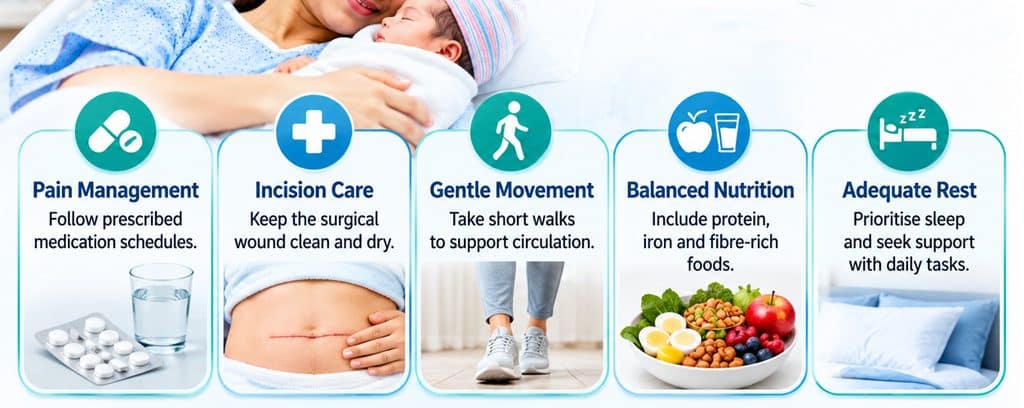
It is possible to have a smoother recovery process through these minor activities that include managing pain, taking care of the incision site, moving about, as well as eating and resting properly.
1. Stay Ahead of the Pain
Keep taking pain medication on time even before you feel any pain. Medications available in the market, such as paracetamol or ibuprofen, work, but you should talk to your doctor about them. Codeine is advised against by Tommy’s for pain relief while breastfeeding because of potential risks to the infant.
2. Incision Care
Maintain the wound clean and dry. Gently pat dry the area after a shower and refrain from scrubbing it. Do not soak yourself in baths or hot tubs until your physician declares it safe to do so. Loose-fitting and high waistline cotton clothing help you avoid rubbing of the wound. Once the wound heals completely, your doctor can advise you to massage it using unscented moisturiser.
3. Move Smartly
- Hold a pillow close to your stomach whenever you sneeze, cough or even laugh.
- To get up from bed, first roll onto your side and then swing your legs off the side of the bed.
- Walk shorter distances a few times during the day, and then increase it each week.
- Avoid carrying anything very heavy for six to eight weeks.
4. Eat and Drink for Healing
Healthy food helps in tissue regeneration and prevents constipation, which will save your stitches from undue stress.
- Protein-rich foods: eggs, fish, chicken, paneer, curd, dal and sprouts
- Fibre-rich foods: oats, poha, whole wheat roti, brown rice and green leafy vegetables
- Iron-rich foods: spinach, lentils, dates and dry fruits to compensate for blood loss
- Vitamin C-rich foods: oranges, papaya, kiwi and broccoli for collagen formation
- Fluids: Drink water 2-3 litres per day, including soups, coconut water and buttermilk
Limit highly spicy, greasy, and gas-forming foods initially. Frequent small meals are easier on the tummy.
5. Rest and Accept Help
Sleep when your baby sleeps. Ask family and friends to help you with your cooking, cleaning, and errand activities. Getting enough sleep is what’s best for you after a C-section.
6. Know the Rules for Driving, Exercise and Intimacy
- Driving: Wait approximately two weeks until you are able to comfortably turn your body and use the pedals.
- Exercise: Start with walking and pelvic floor exercises. It is recommended to begin core exercises only after getting approval from your physician.
- Intimacy: At least six weeks or when your doctor gives the go-ahead. Use pads instead of tampons until bleeding stops.
7. Look After Your Mind
Changes in mood and crying during the initial two weeks of life are common and termed “baby blues.” However, if feelings of unhappiness, fear, or hopelessness persist beyond that point, you should see your doctor about postpartum depression.
Warning Signs: When to Call Your Doctor
Although pain can be considered a normal phenomenon, there are specific situations where immediate action must be taken. These include the following:
- Pain, redness, pus, drainage from the surgical wound
- Fever of 38°C (100.4°F) or above, or chills
- Heavy bleeding, or bleeding with an unpleasant smell
- Increasing pain despite pain medications
- Pain, redness, swelling of one calf
- Pain in the chest, coughing, or shortness of breath, indicating blood clotting
- Burning or difficulty urinating
- Red, hard, tender breasts that get increasingly worse in 24 hours
How to Select a Right Gynaecologist for C-Section
Your gynaecologist guides you before, during and post-surgery, so the choice matters. Search for someone who is:
- Experienced and qualified: Registered obstetrician and gynaecologist who performs both normal and surgical deliveries on a regular basis.
- Communicative: Should be able to clearly explain when the need for a C-section arises and should listen to your wishes regarding the same.
- Facility to handle complications: Hospital which has operating theatre, blood bank, ICU and neonatal facility round the clock
- Post-delivery care: Wound examination, check-up at six weeks, feeding and contraceptive counselling
Questions worth asking: Do I need to have a C-section delivery? Which incision will you make? How long will I stay? What pain relief measures will you provide? Who should I approach if I have any apprehensions after discharge?
C-Section Care at SilverStreak Hospital, Gurugram
SilverStreak Multispeciality Hospital is situated in Sector 87, facing DLF Skycourt, Gurugram. This is an NABH-certified hospital with 350+ beds, 15+ specialities and 24×7 emergency services, ensuring expectant mothers are always backed up in their own backyard of New Gurgaon.
This is what mothers can rely on when they are pregnant, undergoing surgery, and recovering:
- Experienced Obstetricians: The Gynaecology wing is responsible for pregnancy, infertility, and gynaecological problems. Dr. Swapnil Agrahari, Consultant in Obstetrics & Gynaecology (MBBS, MS Obstetrics & Gynaecology, F.MAS, D.MAS), is one of the doctors who can provide assistance to mothers.
- Baby Care: The Neonatology and Paediatrics department, which has Dr. Ved Parkash Sharma, a senior paediatrician and neonatologist with 29+ years of experience, is available to attend to your baby.
- Facilities for Surgical Treatment: The hospital also has modernised operation theatres, Intensive Care Units and in-house diagnostic facilities like ultrasound.
- Antenatal care packs: The ANC pack includes tests such as a complete blood count, blood grouping and Rh factor, and a glucose tolerance test, with results provided within 24 hours.
- Complete body well-being: You can avail physiotherapy, Clinical Nutrition and Dietetics, and psychiatry for problems related to movement, diet, and low spirits after delivery.
- Convenient cashless admission: Cashless admission facility is available through 40+ insurance companies and TPAs, depending on the terms of your policy and approval from the insurance company.
If you or your loved ones are looking for comprehensive care during and after C-section surgery, visit the gynaecologist at SilverStreak Hospital.
Conclusion
C-section is a big surgery, and recovery after it is a slow process. It is mostly about common things that work for almost everybody: sleep when you can, go walking daily, eat healthy food, take care of your wound, and let people help you. You should listen to your body, attend all check-ups and be in touch with your doctor.
FAQs
Most women will recover in 4 to 8 weeks. It will take about 6 weeks to completely heal the incision, but regaining energy and comfort will take longer, especially with an infant to look after.
You will be advised to take a short walk after 24 hours. This will improve the circulation of blood and reduce the formation of blood clots.
It is usually advised to wait for about 6 weeks and then receive permission from your doctor at the check-up.
In most cases, yes. VBAC success rate lies between 60 and 80 per cent, with minimal chances of uterine rupture less than one per cent. It is safer after a single low transverse incision.
Yes. It may take several months to regain sensation in that part of the body. Please notify your doctor in case of redness, swelling and pain in the affected area.