
Gallbladder
Gallbladder Problems: Symptoms & Diagnosis
Gallbladder symptoms and causes affect millions of people worldwide. You can misidentify this condition as acid reflux, a pulled muscle, or a heart problem. Therefore, it is important to know the function of gallbladder in the human body. Also, understanding gallbladder symptoms and causes is the first step toward rapid diagnosis and lasting relief.
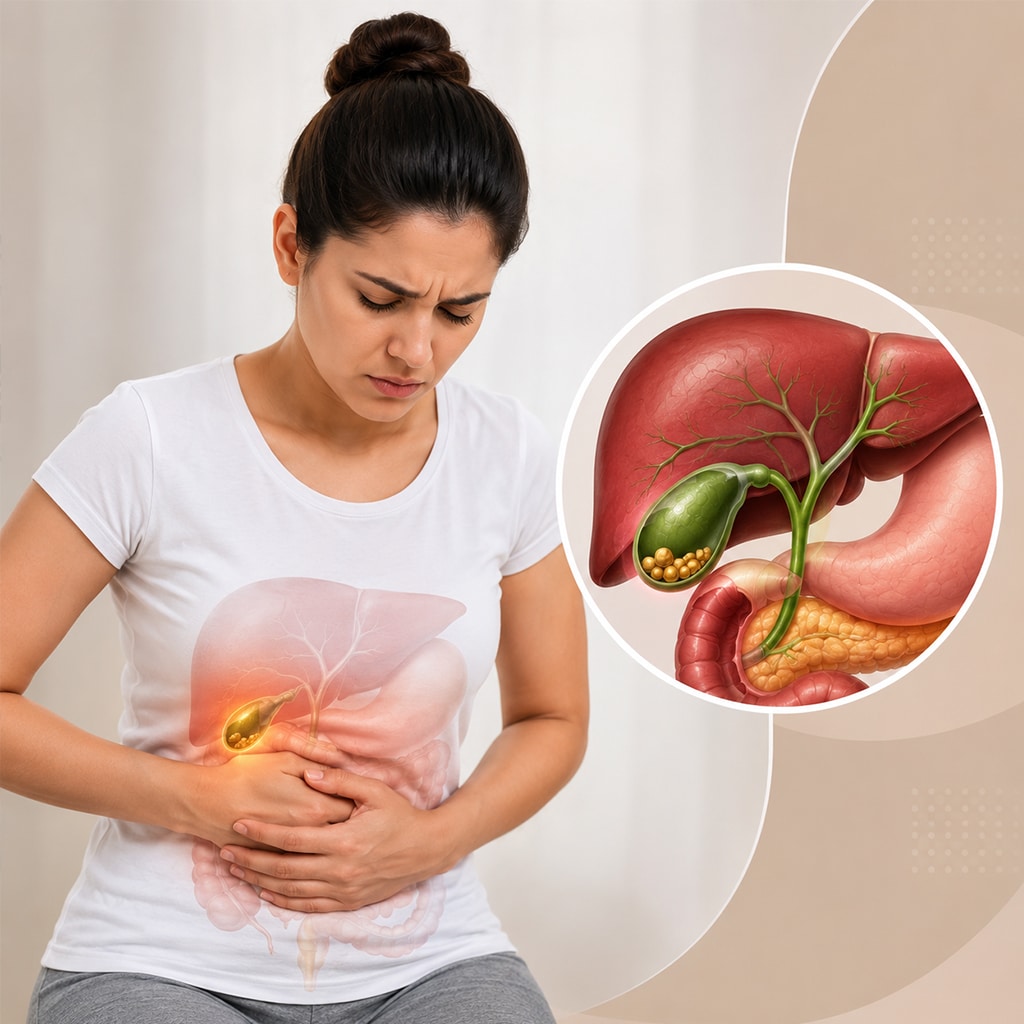
The gallbladder is a small, pear-shaped, pouch-like organ. It sits beneath the right lobe of the liver. It stores and concentrates bile: the digestive fluid your liver produces to break down dietary fats. When you eat a fatty meal, the gallbladder contracts, pushing bile into the small intestine through the bile duct. If this system does not work smoothly, it can make life miserable.
What Is the Gallbladder & Why Does It Fail?
A bad gallbladder can develop several types of disease. But the most common issue is the formation of gallstones (cholelithiasis). Gallstones are hard deposits that form when bile contains too much cholesterol, too much bilirubin, or too few bile salts to keep everything in solution.
They range in size from a grain of sand to a golf ball. Plus, a single gallbladder may harbor one large stone or hundreds of tiny ones. Other gallbladder conditions include:
- Cholecystitis: An inflammation of the gallbladder wall, often triggered by a stone blocking the cystic duct.
- Biliary dyskinesia: A motility disorder where the gallbladder doesn't contract properly.
- In rare cases, gallbladder polyps or gallbladder cancer.
Gallbladder Symptoms and Causes
Gallbladder disease is notorious for mimicking other conditions. The hallmark presentation is biliary colic: a sudden, intense pain in the upper right or central abdomen. Usually, it begins 30 to 60 minutes after a fatty meal.
Unlike the cramping of irritable bowel syndrome, biliary colic tends to be steady and severe, not wave-like. Sometimes, it radiates to the right shoulder blade or the back between the shoulder blades. You need to know: ‘What are the first signs of a bad gallbladder?’
Abdominal Pain
It is the most reported and most defining symptom of gallbladder disease. You can have intense and steady pain in the upper right quadrant or epigastrium. It may last one to five hours before subsiding on its own.
Nausea & Vomiting
Generally, nausea accompanies attacks. Vomiting may occur. But it rarely brings relief. Unlike with other gastrointestinal conditions, this is a useful distinguishing clue.
Back & Shoulder Pain
Referred pain under the right shoulder blade or between the shoulder blades is a classic red flag. You may overlook and misattribute to musculoskeletal causes.
Bloating & Indigestion
You may experience persistent bloating, belching, and a feeling of fullness after small meals, especially following fatty or fried foods. They are common early indicators that something is wrong with bile flow.
Fever & Chills
The presence of fever signals infection or acute cholecystitis. So, it requires prompt medical evaluation. You should not wait at home if you have this symptom.
Jaundice
Yellowing of the skin or the whites of the eyes indicates obstruction of the bile duct. It is a medical emergency and requires immediate attention. If you develop sudden, severe abdominal pain along with fever, jaundice, or a rapid heart rate, go to an emergency care facility in no time. These gallbladder symptoms can indicate acute cholecystitis, gallstone pancreatitis, or ascending cholangitis. They are all serious conditions that need urgent treatment at a healthcare facility like SilverStreak Hospital, Gurgaon. We have an emergency care unit open 24/7.
What Causes Gallbladder Disease?
Understanding the root causes of gallbladder symptoms helps explain why certain people are far more susceptible than others. So, specialists always try to find the actual reason behind the disruption in your gallbladder functions.
Basically, the causes of gallbladder diseases are multifactorial. They are a combination of genetics, metabolism, diet, and lifestyle. Read on to discover them in detail:
Cholesterol Imbalance
When bile is supersaturated with cholesterol, crystals form and gradually solidify into stones. This is the mechanism behind cholesterol gallstones, which account for roughly 80% of all cases.
Excess Bilirubin
Conditions such as cirrhosis, sickle cell anemia, or biliary tract infections cause the liver to overproduce bilirubin. They result in the formation of pigment gallstones, a darker and harder type.
Poor Gallbladder Motility
If the gallbladder does not empty efficiently, bile becomes concentrated and stagnant. Eventually, it creates an ideal environment for stone formation. Prolonged fasting, pregnancy, and certain medications are common contributors.
Diet & Obesity
A diet high in refined carbohydrates and saturated fats raises cholesterol secretion in bile. Obesity, and particularly rapid weight loss through crash dieting, increases the risk of gallstone formation.
Medications & Hormones
Oral contraceptives and hormone replacement therapy raise estrogen levels. It elevates cholesterol in bile and reduces gallbladder motility. Besides, certain cholesterol-lowering drugs can raise gallstone risk as a side effect.
High-Risk Populations & Communities
Gallbladder disease does not strike randomly. The well-established "4 F's" mnemonic in medicine captures the most common risk profile: Female, forty-plus years of age, fertile (pregnancy history), and fat (overweight or obese). Beyond this, additional risk factors are:
- Family history
- Diabetes
- A sedentary lifestyle
- A high-fat diet
- Rapid weight loss
- Native American or Hispanic heritage.
Up to 20% of adults over 40 have gallstones, though the majority will never experience symptoms. The challenge lies in identifying those whose stones will eventually cause problems. For this: you can avail yourself of Silverstreak Hospital’s preventive healthcare packages at an affordable price.
How to Diagnose Gallbladder Disease
Gallbladder symptoms and causes overlap with so many other conditions: peptic ulcers, pancreatitis, hepatitis, and cardiac events. So, accurate diagnosis is not enough. Rather, it requires a structured clinical approach. It involves patient history, physical examination, and targeted testing. At SilverStreak Hospital in Gurgaon, we use the following techniques to detect gallbladder diseases:
Physical Examination
A physician will palpate the upper right abdomen and may extract Murphy's sign. They try to detect pain on deep inspiration while pressing under the right rib cage. Most importantly, it is a specific indicator of gallbladder inflammation. The presence of fever, rigidity, or rebound tenderness points toward a more serious disease.
Our gastroenterologists are experts at examining patients to find out if they have any gallbladder problems. Apart from physical examination, Dr. Abhijeet Ranjan, our specialist, will listen to your symptoms carefully and recommend some diagnostic tests to confirm your gallbladder disease.
Diagnostic Tests
Abdominal ultrasound is the first-line investigation. It detects gallstones, a thickened gallbladder wall, ductal dilation, and free fluid around the organ.
Our advanced laboratory and diagnostic services perform this with accuracy. If you have gallstones larger than 5 mm, ultrasound can detect them in a precise manner.
Liver Function Tests (LFTs) measure bilirubin, ALT, ALP, and GGT. Elevated levels suggest bile duct obstruction or hepatic involvement. In this case, patients need further testing.
A complete blood count (CBC) is used to detect white blood cells. It indicates infection or acute inflammation consistent with cholecystitis.
A CT scan of the abdomen is reserved for complex or atypical presentations. It is suitable for detecting complications, such as perforation, abscess formation, or involvement of adjacent organs.
A HIDA scan measures gallbladder function and ejection fraction. This is the gold standard for diagnosing biliary dyskinesia. Doctors suggest it when the ultrasound appears normal, but symptoms persist.
Surgeons use MRCP and ERCP to diagnose stones in the common bile duct. Also, ERCP serves a therapeutic purpose. It allows surgeons to directly remove stones during the same procedure.
Gallbladder Treatments
Once your doctor confirms gallbladder disease, management will depend on severity. Uncomplicated biliary colic may be handled through dietary modification, adequate hydration, and pain management.
On the other hand, awaiting elective cholecystectomy is the definitive treatment. Usually, acute cholecystitis requires hospitalization, antibiotics, and laparoscopic surgery.
Also, lifestyle adjustments play a meaningful role. A diet rich in fiber, healthy fats, such as olive oil, and lean protein supports healthy bile flow. Regular physical activity helps maintain a healthy weight. It reduces cholesterol concentration in bile.
Especially, avoiding prolonged fasting and crash diets is important. They are well-documented triggers for gallstone formation.
Meet SilverStreak's Gallbladder Stone Specialists in Gurgaon
Dr. Utkarsh Gupta — Laparoscopic & Robotic Gallbladder Surgeon, Gurgaon
Dr. Utkarsh Gupta has specialized in advanced laparoscopic and robotic-assisted cholecystectomy in both routine and complex/high-risk patients after obtaining his surgical training at Indraprastha Apollo Hospital, New Delhi, one of the leading institutions in the country for minimally invasive surgery.
His area of expertise and greatest strength as a surgeon is in the treatment of complex gallbladder cases: large or impacted stones, acute inflammation, patients present to the hospital with recurrent biliary colic, and high-risk patients where a more delicate approach is required. With the use of the robot and laparoscopic approach, he is consistently achieving bloodless surgery with near-invisible wounds and rapid recovery.
Dr. Paras Kumar Gupta — Senior Gallbladder Stone Surgeon, Gurgaon
Dr. Paras Kumar Gupta brings over 12 years of dedicated laparoscopic surgery experience, with a strong record in gallstone removal across varying levels of complexity. He routinely manages inflamed gallbladders, infected stones, and acute presentations—cases where surgical judgment matters as much as technical skill.
His practice is built on three priorities: minimal patient discomfort, short hospital stays, and reliable long-term outcomes. Patients across Gurgaon consistently return to him — and refer others — based on his calm, thorough approach and the predictability of his results.
Dr. Paras Kumar Gupta Senior Gallbladder Stone Surgeon, Gurgaon
Dr. Paras Kumar Gupta has now gained over 12 years of experience in dedicated laparoscopic surgery, including a high volume of both straightforward and difficult gallstone cases, including inflamed gallbladder, infected stones, and acute cases where individual judgment is critical as well as technical expertise.
His practicing standards revolve around three tenets: least harrowing to the patient, shortest possible stay, and dependable long-term results. Patients from around Gurgaon keep coming back and also recommend him owing to his unruffled procedure and assured results.
How to Choose the Right Gallbladder Surgeon in Gurgaon
The success of gallbladder surgery is largely dependent on the surgeon's training, technique, and technology used. When considering a specialist, take these four points into account:
Laparoscopic Specialization — Keyhole (laparoscopic) cholecystectomy is considered the standard procedure for the removal of the gallbladder. If a surgeon does this on a regular basis, not just occasionally, they will be familiar enough to lower your risk of complications.
Minimally Invasive Technique Range — The best surgeons will have options other than the standard laparoscopy, such as single-incision laparoscopic surgery (SILS). There are fewer incisions, which results in quicker healing, less pain after surgery, and better cosmetic results.
Surgical Technology Available—4K laparoscopy procedures provide much greater visual clarity. This equates to safer dissection around the bile duct, more accurate tissue handling, and reduced conversion to open surgery.
A surgeon's complication rate is directly related to his/her experience in surgical volume and case complexity. The greater the number of cases, particularly those with challenging gallbladder anatomy, the less likely there will be an injury to the duct, a postoperative infection, or an unplanned conversion to open surgery.
Book a Consultation with Us!
Don't dismiss persistent upper abdominal discomfort, especially after fatty meals. What feels like ordinary indigestion may be a sign of your gallbladder problems. Early evaluation, including a simple ultrasound and blood panel, can provide clear answers quickly. Thus, you can prevent far more serious complications down the road. When it comes to gallbladder symptoms and causes, it is essential to consult a specialist. Schedule a consultation with our doctors at SilverStreak Hospital, Gurgaon.
Frequently Ask Questions
Can I prevent gallstones?
Though you cannot prevent all gallstones, you can minimize the risk by following a balanced lifestyle. You should maintain a fiber-rich, healthy diet and an ideal weight. In addition, you need to stay hydrated to ensure proper bile function.
Does every gallstone require surgery?
If gallstones are small and asymptomatic, doctors recommend diet, medications, and lifestyle changes. When you experience recurrent pain and complications due to gallstones, you may need to undergo surgery.
What are the risks of untreated gallstones?
Untreated gallstones can result in serious complications. They include cholecystitis, bile duct obstruction, and pancreatitis. Patients can face severe pain, jaundice, infection, fever, and other issues.
Which foods do you need to avoid if you have gallbladder problems?
You need to avoid fatty, fried, or processed foods since these foods can aggravate gallbladder symptoms. Red meat, full-fat dairy, butter, and sugary desserts are common triggers for gallbladder problems.
Can I live without a gallbladder?
Yes, you can live without a gallbladder. The liver still produces bile, released directly into the small intestine. While you may face some digestive concerns, most people adapt well by making dietary adjustments.