


Hair fall reasons include genetics, stress, hormonal changes, lack of iron and vitamin D, thyroid issues, certain medications, and tight hairstyles. An average person sheds 50 to 100 hairs daily. So, it is quite normal to shed hair sometimes. However, in case you start noticing increased shedding, widened parting, and even bald spots, it is better to find out the cause. There are various treatments for different kinds of hair fall. Early diagnosis will give you more opportunities to fight hair fall. At SilverStreak Hospital, the dermatologists find out the cause first and then proceed to treatment.
Hair Fall Causes: What Is Normal and What Is Not
Some hair loss is a natural thing in our lives. The American Academy of Dermatology says that losing 50-100 hair strands daily is normal. Problems begin to arise when we start to lose hair faster than our head can grow new ones.
Understanding the Hair Growth Cycle
Each hair follicle has its own hair growth cycle. There are three major stages in the hair growth cycle:
| Phase | What happens | Approximate duration |
| Anagen (growth) | The follicle is actively producing new hair. The majority of scalp hair is in this stage at any point in time. | 2 to 7 years |
| Catagen (transition) | The growth ceases, and the follicle atrophies. | 2 to 3 weeks |
| Telogen (rest and shedding) | The old hair gets tired and falls out to make way for a new hair underneath. | About 3 to 4 months |
The most common reasons for hair loss are disruptions to the hair growth cycle. Emotional stress, sickness, and hormonal changes can force many strands to enter the shedding stage at one time. Genetic hair loss means shorter growth periods and progressively smaller follicles.
Three Types of Hair Loss
As mentioned by American Family Physician, doctors classify hair loss without scarring in three different patterns:
- Patterned: thinning in characteristic places, like the temporal area, the vertex, and the part (androgenetic alopecia).
- Diffuse: overall thinning on the scalp (telogen effluvium is an example).
- Focal: localised areas of baldness (for instance, alopecia areata).
Knowing your pattern gives your doctor an early clue about the cause.
10 Common Hair Loss Causes
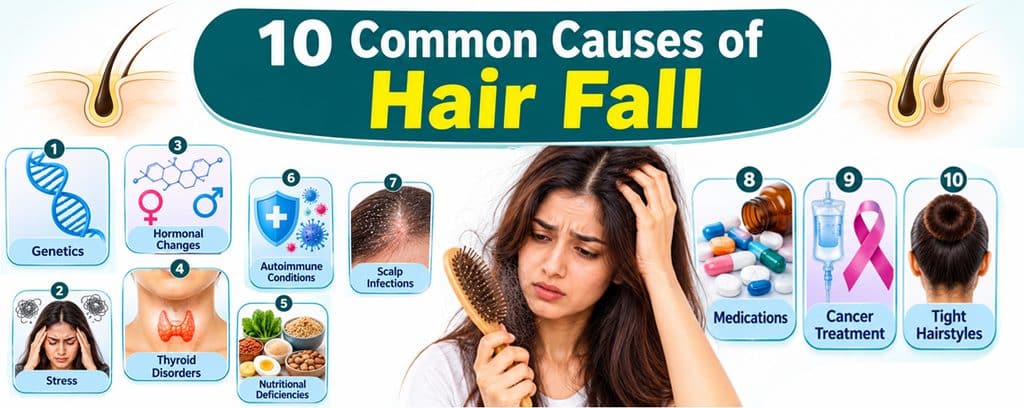
These are the most prevalent cases of hair loss diagnosed in clinics. Multiple cases may occur together.
1. Genetic Predisposition and Age (Pattern Hair Loss)
Pattern hair loss is the most common type of hair loss. According to MedlinePlus, the condition occurs in more than 50 million American males and 30 million American females. The condition is inherited genetically and involves multiple genes, including paternal genes.
For men, the hair loss begins in the temples and the crown of the head. In women, there is widening of the parting without the receding hairline. Additionally, hair loses thickness as one gets older.
2. Stress and Telogen Effluvium
Extreme stress caused by either a physical or emotional shock may cause an abrupt thinning. Examples include surgery, high fever, severe sickness, starvation diets, and death of a close relative.
The delayed reaction is often misunderstood. Thinning normally occurs 2 to 3 months following the trigger and reaches its peak a few months after that. Hair regains its normal state between 6 and 9 months after the stress has been removed.
3. Hormonal Imbalances
Hormonal imbalances greatly affect the growth of hair. For instance:
PCOS: High levels of androgens result in thinning of hair along with acne and irregular periods.
Pregnancy and childbirth: Women experience excessive loss of hair a few months post-delivery.
Menopause: Reduced estrogen causes hair thinning.
Withdrawing from birth control pills: In many cases, women experience hair loss.
In most of these scenarios, hair regains its health with the correction of hormones.
4. Thyroid Disorders
An overactive or underactive thyroid can disrupt hair growth, leading to hair thinning all over the scalp. Tiredness, weight loss, skin dryness and being extremely sensitive to cold and hot conditions are other symptoms associated with this condition. Testing the functioning of the thyroid is easy through blood tests.
5. Nutritional Deficiencies
The hair follicle is a very metabolically active tissue and requires a constant supply of nutrients. Nutritional deficiencies such as iron, vitamin D, and riboflavin have been shown to cause hair loss in a review in Dermatology and Therapy. Protein deficiency and starvation diets may also induce hair loss.
Note of caution: supplements do not always improve hair growth, and their use without testing is a waste of money.
6. Autoimmune Conditions
In some autoimmune disorders, the body’s immune response targets normal hair follicles.
- Alopecia areata results in coin-sized patches of hair loss. The hair will often regrow spontaneously, although treatment may be beneficial for persistent alopecia.
- Lupus may cause hair thinning or patches associated with scaling skin.
- Thyroid autoimmune disorders may contribute to hair thinning.
7. Scalp Infections
Scalp fungal infections (tinea capitis) produce symptoms such as itching, scaling, redness, and hair loss in patches. They are the most common cause of hair loss among children, who acquire it through the sharing of hair accessories, like combs and hats or even towels.
The treatment involves the use of antifungal medication. However, failure to do so promptly may lead to scarring. It is advised that one should avoid treating a scaly and patchy scalp with home-made remedies.
8. Medicines and Side Effects
There are medicines that are known for causing hair loss in certain individuals. Such medicines include cholesterol medications, high blood pressure medication, blood thinners, antidepressant drugs, skin care medications such as isotretinoin and weight loss medication.
9. Cancer Treatment
Chemotherapy targets rapidly dividing cells; therefore, hair loss is one of its known side effects. Radiation results in hair loss only in the areas where it is administered. According to the American Cancer Society, hair grows again once the therapy stops.
10. Hairstyling and Hair Care Habits
Tight ponytails, braiding, extensions, use of heat styling tools, and chemical hair treatment may cause follicle damage. Persistent traction for many years leads to scarring of the follicles, which does not allow hair growth. The AAD recommends avoiding hairstyles that put tension on hair.
Hair Shedding vs. Hair Loss
Both terms seem to be similar, but they have a difference between them. Shedding is defined as hair falling out. On the other hand, hair loss refers to the condition where something prevents new hair from growing again. Temporary shedding can often be resolved by itself after some time. Persistent thinning should be evaluated properly.
When to See a Doctor for Hair Loss
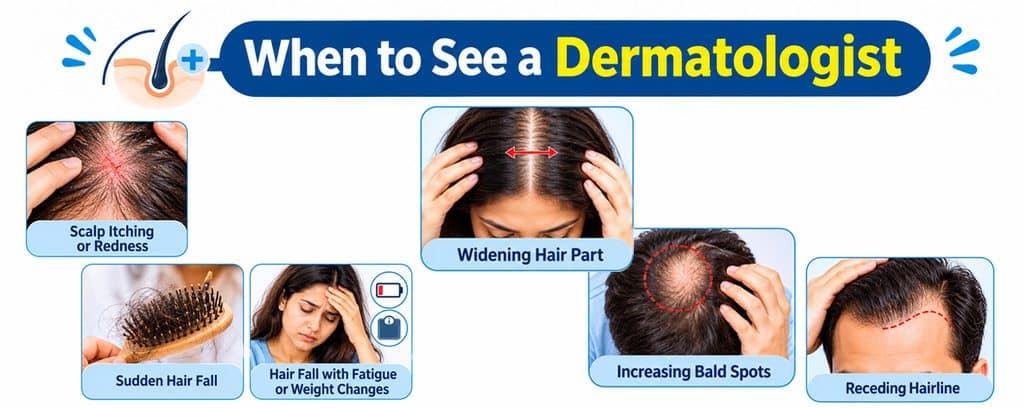
Schedule an appointment with a dermatologist if you observe:
- A less thick ponytail or a broader part
- Gradually increasing bald spots
- Receding hairline or lack of sharp line of hair separation
- Scalp itching, scaling, reddening, or painful pustules
- Hair fall onset following the intake of a new drug, a recent surgery, or an illness
- Fatigue, unexpected changes in body weight, or irregular menstruation cycle along with hair fall
- Postpartum shedding that has not been recovered in almost one year
Hair loss is a condition which is rarely a medical emergency; however, early evaluation helps your physician have a wider variety of treatment options.
How Physicians Determine the Root of the Problem
An accurate diagnosis plays an important role in hair fall treatment. You can expect the following during your consultation:
- A comprehensive history: dietary habits, stress, recent diseases, medications, and personal and family history and hair practices.
- A scalp and hair examination: pattern of hair loss, appearance of the scalp, and pull test.
- A blood test: This may include complete blood count, ferritin (body iron stores), thyroid function test, vitamin D, and vitamin B12 levels. Female patients may be asked to have a hormone profile test if PCOS is considered in their case.
- Scalp biopsy: In some instances, a skin biopsy from the scalp is done under a microscope.
Hair Fall Treatment: Options Depend on the Cause
Not all hair fall remedies will suit everyone. The proper method to use is based on the cause of hair loss.
- Treat The Cause Of The Problem
In case of a blood test showing low levels of iron, vitamin D, or thyroid hormones, then treating these issues is the first step. In cases of infections, antifungal medicines are used. If the culprit is the drug, your doctor can change it.
- Medicine Treatment for Patterned Baldness
As noted by American Family Physician, the common prescription drug for the treatment of hair loss is minoxidil. For men, there is finasteride in oral form. This drug is not good for pregnant women hence should be taken according to doctors’ recommendation.
The process is slow. Most patients need to use the drugs for some months to see the result, and most have to continue using the medicine.
- Treatment of Alopecia Areata
If it is mild, it may grow back on its own without treatment. In some cases, a dermatologist can recommend injections, topical creams, or newer prescriptions.
- Procedures and Other Advanced Treatments
Sometimes a dermatologist may offer procedures like PRP, low-level laser therapy, and hair transplant surgery. Depending on the evidence and appropriateness of each procedure to one’s condition, these can be considered after a correct diagnosis is made. Hair transplants do not cure hair loss, so other medical treatments continue at the same time.
Everyday Habits That Support Healthy Hair
Good habits may not resolve all the reasons, but they will limit unnecessary harm:
- Ensure that you consume enough proteins, iron, and vitamin C food items. Take iron food items like spinach, dal, and beetroot along with lemon or amla.
- Wash your hair regularly, use mild shampoo and do not rub your wet hair.
- Use a wide-tooth comb and be careful with wet hair.
- Minimise tight hairstyles, heat, or chemicals in your hair.
- Make sure you have adequate sleep and practice stress-reduction methods like walking and breathing exercises.
- Do not use combs, towels, or hats shared by others.
- Do not take any serums or supplements without consultation.
Hair Fall Care at SilverStreak Hospital
In Sector 87, Gurugram, there is SilverStreak Multispeciality Hospital, which has a Department of Dermatology and Aesthetic Surgery, laboratory service, Internal Medicine, as well as a clinical nutrition and dietary department. It becomes possible to analyse hair fall from several sides. Our specialist, Dr. Shobhita Gupta, will inspect your head, and related departments will help in case of conducting certain tests and nutritional counselling.
At the visit, it will be necessary to provide the list of the drugs you take, results of the recent blood test and pictures which reflect the appearance of your hair before.
Conclusion
There are a variety of reasons for hair fall, but your hair loss cause is often difficult to determine just by looking in a mirror. Genetics, stress, hormonal imbalances, thyroid disorders, lack of iron or vitamin D, medications, infection, and hairstyling practices can all contribute to hair fall. Learning about the hair growth cycle will help explain why hair loss occurs several weeks or months after a trigger.
The best course of action here is to find out the underlying cause of hair fall. When that is done, the appropriate treatment options can be recommended depending on what the specific cause is, be it a deficiency, a medical condition, a behaviour change, or a medication. It is a process that takes time and varies from one person to another.
If you are concerned about your hair fall, there is no need to figure everything out by yourself. At SilverStreak Hospital, Sector 87, Gurugram, our dermatology experts can give you an examination of your scalp and recommend the necessary tests. Book an appointment to consult with a doctor.
FAQs
Normally, about 50-100 hair strands fall out in one day. If you see this happening frequently or hair thinning, it can mean the need for a doctor’s visit.
In most cases, yes. The temporary nature of telogen effluvium makes it regrow in 6-9 months after resolving the cause.
It all depends on the root of the problem. Stress-related, hormonal and nutritional deficiencies make hair loss reversible. If follicle damage occurs, it cannot be reversed.
Tests may include a blood test, ferritin test, thyroid test, vitamin D test, and B12 test. Your doctor will be able to determine the tests that you need.
There is no clear answer to this question, but it is possible to exert pressure on your hair follicles if you wear too tight a hat.