


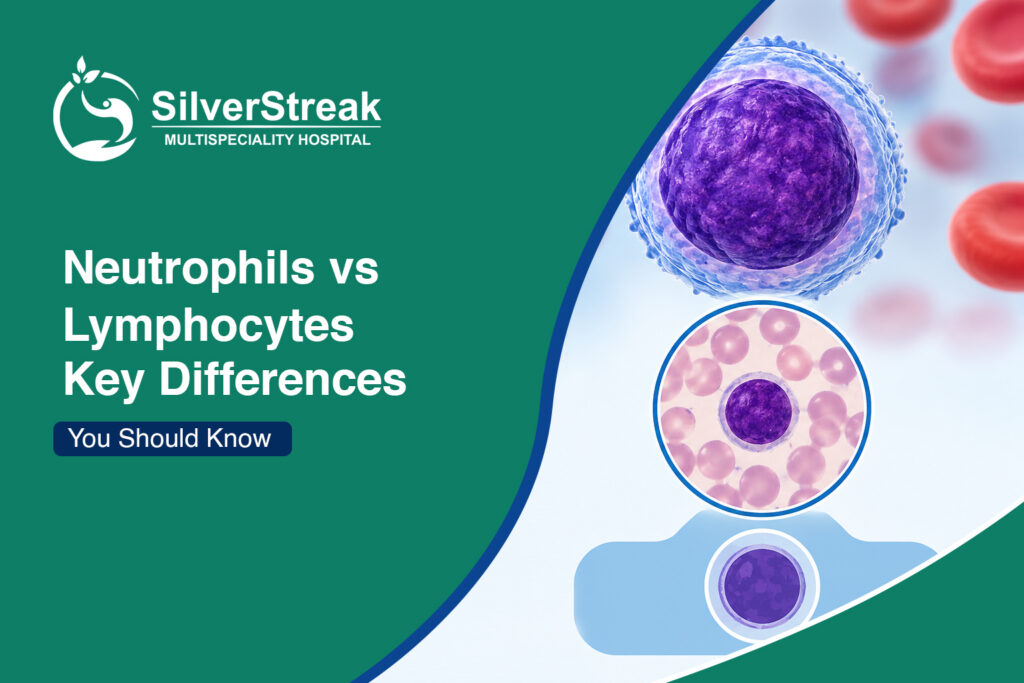
The contrast between neutrophils and lymphocytes always emerges as an intriguing topic when a person receives a blood test report. Despite the fact that both neutrophils and lymphocytes are kinds of white blood cells, they perform entirely different functions in the body. Neutrophils are quick cells that act as protectors of the body against bacteria causing infection and help clear any damaged tissues in the body, whereas lymphocytes are slow to produce antibodies.
This article elaborates on what these cells are all about and their differences.
What Are Neutrophils?
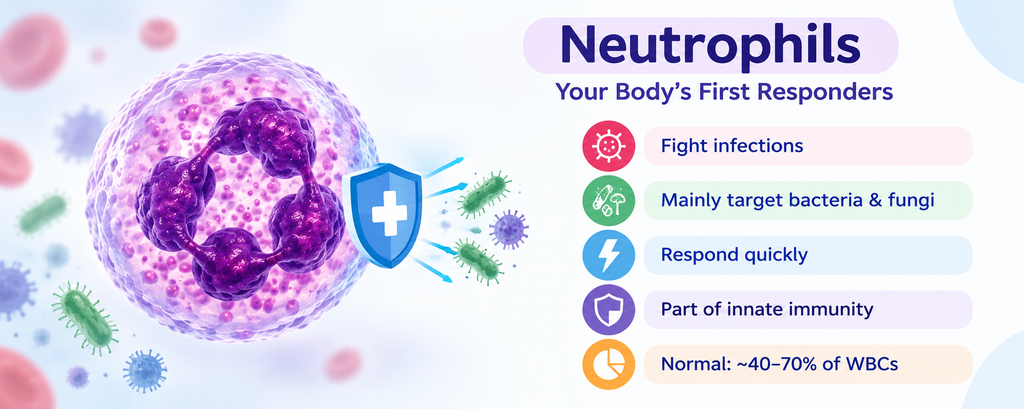
The neutrophils represent the most numerous group of white blood cells in the body of adults. The formation of neutrophils occurs in the bone marrow, and they are located in the blood. Neutrophils are the elements of the innate immune system; therefore, the reaction appears instantaneously, and the detection of the pathogen is not necessary.
As soon as the infection is brought by the bacteria into the wound, the neutrophils are drawn to the damaged area because of the effect of certain chemicals. Neutrophils phagocytise the microorganisms, release enzymes, and cause inflammation. This results in redness, swelling, and an increase in skin temperature.
Neutrophils live very briefly, for hours to days. This means that neutrophils have to be produced continuously by the body.
What Is the Normal Range for Neutrophils?
Neutrophils can be presented in two forms: in the first form, neutrophils are presented in absolute values (cells/microliter of blood), and in the second form, neutrophils are presented in the form of percentages of white blood cells.
- The normal neutrophil range is from 2,500 to 7,000 cells/microliter of blood.
- However, some laboratories can present neutrophils as from 1,500 to 8,000 cells/microliter of blood.
The normal ranges may differ according to the laboratory, age, and population group. There are some healthy individuals who fall into the lower range normally.
When the counts of neutrophils rise, this condition is known as neutrophilia. On the other hand, if the numbers are lower than normal, this is neutropenia. Many factors can cause neutrophilia and neutropenia. If your neutrophil count is repeatedly outside the normal range, a general physician can help evaluate the result.
What are Lymphocytes?
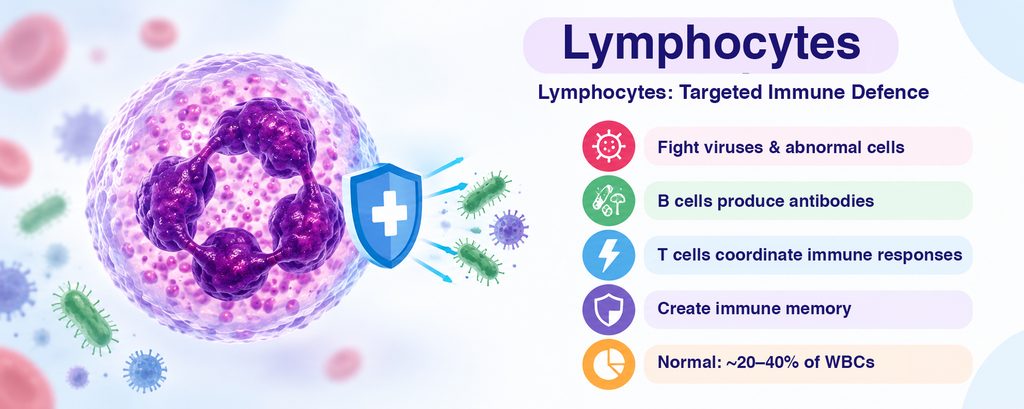
Lymphocytes are part of the adaptive immune system. It takes some time before they respond, but they are accurate and lasting. The three primary kinds of lymphocytes are:
- B cells produce antibodies that bind to a particular pathogen.
- T cells organise the immune response and destroy any infected or abnormal cells.
- Natural Killer (NK) cells kill virus-infected and some abnormal cells without having learned before.
The main characteristic of the lymphocytes is their memory. The next time you face a pathogen, your B and T cells will remember it. Vaccines use this mechanism.
What is Normal Lymphocyte Count?
Lymphocytes account for about 20 to 40 per cent of the total number of white blood cells.
Excessive levels of lymphocytes in blood indicate a condition called lymphocytosis. If there are fewer lymphocytes present, the condition is referred to as lymphopenia. The lymphocyte count in children is always higher compared to that of adults. Persistent changes in lymphocyte levels may require evaluation by a general physician.
6 Major Differences between Neutrophils and Lymphocytes
Both cells help you in their unique way. Understanding their differences will help you interpret your blood report more easily. Here are the six main dissimilarities between the two cells.
- Response time
Neutrophils get to the spot within minutes to hours. Days are required by lymphocytes to give an immune response to a new stimulus. Imagine neutrophils as firemen and lymphocytes as detectives trying to understand what exactly occurred.
2. Type of immunity
Neutrophils represent innate immunity and will respond similarly to all sorts of stimuli. Lymphocytes possess adaptive immunity and will customize their response to particular pathogens.
3. Memory
Neutrophils lack memory. Lymphocytes have memory, which explains why you rarely suffer from the same disease twice.
4. Lifespan
Neutrophils have a very short lifespan. Some lymphocytes, particularly the memory cells, can live many years.
5. Main targets
Neutrophils are particularly efficient against bacteria and fungi. Lymphocytes deal with viruses, make antibodies and identify abnormal cells.
6. Stimulants for change in levels
Neutrophil levels often increase in the case of acute infection, trauma, intense physical activity, smoking and certain medications like corticosteroids. Lymphocytes will elevate during certain viral infections and decline during serious disease, physical stress and certain medication use.
The White Blood Cell Differential Explained
The white blood cell differential is the portion of the CBC where your total white cells are broken down into five categories:
- Neutrophils
- Lymphocytes
- Monocytes
- Eosinophils
- Basophils
Your total white cells can be deceiving without a differential. You could have a normal total count, but elevated neutrophils and low lymphocytes.
Percentages vs Absolute Counts of Neutrophils and Lymphocytes
Both measures will probably appear on your report. However, absolute values are usually more practical.
Percentages could be deceptive, since their sum is always 100%. As the count of neutrophils goes up, the percentage of lymphocytes is bound to drop, regardless of any changes in their actual numbers.
It is quite easy to calculate an absolute value on your own:
Absolute neutrophils = white cells x neutrophils%
Let’s say your white cell count equals 7,000 and neutrophils are 65%. This means that you have 4,550 neutrophils per microliter. And that’s perfectly normal.
Neutrophils High and Lymphocytes Low: What Does It Mean?
Occasionally, they hint at this but fail to do so all the time.
Common Symptoms
- An increase in neutrophils is usually associated with bacterial infection. Lymphocytes increase in some viral infections. But there is always much overlap. Viral infections may lead to an increase in the number of neutrophils, and sometimes even bacterial infections do not.
- As stated in the Neutrophils vs Lymphocytes manual by Labplusarts, “high neutrophils = bacterial” and “high lymphocytes = viral” can never be regarded as absolute truths. Physicians consider many aspects, including blood test results, symptoms, and other examinations prior to treatment initiation.
Studies have suggested that this trend indicates the state of “constant emergency mode,” in which the body is creating a lot of first responders but not enough strategists. This is a useful illustration. It is important to note that a single test does not imply the presence of chronic inflammation or a diagnosis.
Neutrophil-Lymphocyte Ratio (NLR)
Usually, in practice, both values are considered at once when determining the NLR, which is:
NLR = absolute neutrophil count ÷ absolute lymphocyte count
Thus, for example, in the case of having 6.0 neutrophils and 1.5 lymphocytes (both ×10⁹/L), then NLR will be 4.0.
A normal NLR value range according to scientific data is 1.0–3.0 for adults. Anything higher than those numbers means inflammation and stress.
What research says
The NLR has been extensively researched for its predictive value. For instance, a frequently mentioned article published in 2012 in the British Journal of Cancer used data for over 40000 cancer patients. This research showed that an elevated NLR (greater than 4) correlates with worse survival outcomes for patients with cancer. The NLR has also been researched for its value in heart disease and other inflammatory illnesses.
However, two important considerations should be kept in mind:
- The studies above show how NLR works at the population level but not what it predicts for you personally.
- NLR is not an independent diagnostic measure; it is used in combination with others.
Why one result is not a diagnosis
A difficult workout at the gym the day before taking the blood sample, a common cold, steroids or lack of sleep can all shift these values. Many patients receive an abnormal test one time, and a normal test during subsequent tests.
Should the same pattern continue to show, the physician might perform a retest of the CBC, measure CRP or even take a look at your medications.
Can Neutrophils and Lymphocytes Tell Bacterial from Viral Infections?
At times, they suggest this but cannot do so consistently.
A high neutrophil count is common in bacterial infections. An increase in the proportion of lymphocytes is seen in certain viral diseases. However, much overlap occurs. Early viral infections may cause an increase in neutrophil count, and sometimes certain bacterial infections do not cause this.
As pointed out by Labplusarts in its Neutrophils Vs Lymphocytes guide, “high neutrophils = bacterial” and “high lymphocytes = viral” should never be taken as definite facts. Physicians take into account various factors such as blood tests, symptoms, and examinations before starting treatment.
Other White Blood Cells in the Differential
The neutrophils and lymphocytes get more recognition; however, three more cells make up the differential:
- The monocyte cells dispose of waste materials and become the macrophage cells, which aid in the defence and repair of the body in the long run.
- The eosinophils react to allergies and parasites.
- The basophils are rarely seen and play a part in the allergic and inflammatory reactions.
How to Support a Balanced Immune System
Your neutrophil and lymphocyte counts cannot be set. However, activities which will decrease chronic inflammation and stress levels will assist in maintaining a healthy immune system:
- Get enough rest at night (between 7-9 hours). Bad sleep quality leads to increased inflammation levels.
- Have a diet consisting of real foods (vegetables, fruits, beans, whole grains, nuts, olive oil, fatty fish).
- Cut down on the intake of processed foods, sugar, and fried foods.
- Do exercise regularly, but not too much. For instance, the general recommendation would be to do some physical activity for around 150 minutes a week. Too much exercise without adequate rest may cause more stress.
- Practice relaxation exercises like taking a walk, deep breaths, meditation, and spending time outdoors.
- Don’t smoke and limit alcohol intake.
- Maintain a healthy weight, as excess fat can produce pro-inflammatory cytokines.
The listed activities promote general wellness. Though, this list can’t help treat your abnormal blood results. Seek advice from a healthcare professional if you are worried.
When Should You Visit a Healthcare Professional?
You should visit a healthcare professional when:
- Your test results are obviously or consistently abnormal
- You have an ongoing or high fever
- You experience frequent or serious infections
- You are losing weight for no reason, experiencing night sweats or bruising easily
- You have enlarged lymph nodes that do not go down
- You feel extremely fatigued for no particular reason at all
Consult a healthcare provider immediately in case of any severe symptoms like a high fever, as well as low neutrophil counts. Neutropenia causes infections.
Bring all prior blood tests if available. The history is often worth more than a single data point.
Conclusion
At the end of the day, the battle between neutrophils and lymphocytes comes down to a matter of speed versus accuracy. Neutrophils get there first, kill off the bacteria, and leave. In contrast, lymphocytes do things more slowly, but do so accurately and sustain immunity to the pathogens.
Both neutrophil and lymphocyte counts should be analysed within the context of a WBC differential test with specific results and reference values from your own laboratory. High levels of neutrophils and low numbers of lymphocytes could be a sign of a problem, although it is not necessarily the case. More information is required.
Don’t interpret the flagged results from your online report. You can visit one of the leading hospital in Gurgaon SilverStreak and consult a general physician in Gurgaon for appropriate evaluation.
FAQs
That is, neutrophils are rapid responders, whereas lymphocytes are slow responders; neutrophils are nonspecific in their defence action, whereas lymphocytes are highly specific in terms of antibody production.
The count of neutrophils is higher than the count of lymphocytes in a healthy individual. For example, neutrophil count can be 55-70% of all white blood cells, and lymphocyte count can be 20-40%.
Not necessarily; it just means that there is some temporary reason for this condition, for example, infection, stress, exercise, or steroid intake. But it does matter if the condition is chronic or serious.
Many attempts have been made to define the ratio from 1 to 3 in adult people, but the numbers vary, and it is not a diagnostic method.
Yes, both physical and psychological stress will increase neutrophils and decrease lymphocytes due to cortisol. However, this will happen temporarily.
No, you do not have to fast if this test is taken alone. But if it is combined with other tests, such as glucose or cholesterol tests, you should follow the guidelines for that panel.
You will see both values; however, the absolute numbers are more accurate because the percentages change automatically when the number of other cells changes.