



Choosing between C-section vs. normal delivery can be one of the hardest choices during pregnancy. In summary, if there are no medical complications, a normal vaginal birth is usually preferable because it carries fewer risks and a quicker recovery. However, a C-section is recommended when there are risks to you or your baby. The best method will be recommended by your gynaecologist after your examination.
Here, you will find detailed information about each of the deliveries in clear and easy-to-understand terms.
C-Section vs. Normal Delivery: A Quick Comparison
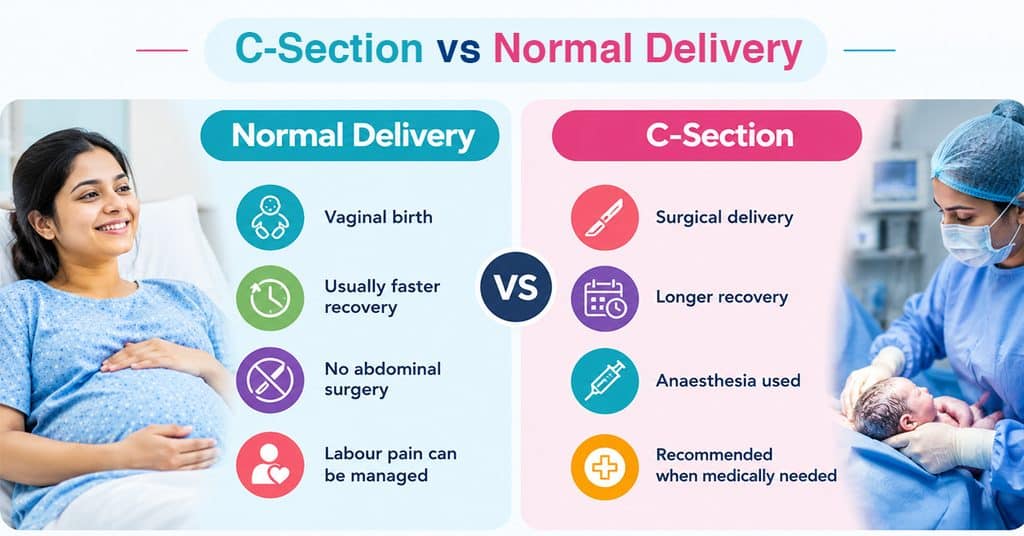
This is a comparison of the major distinctions between vaginal birth and Caesarean section.
| Factor | Normal Vaginal Delivery | C-Section (LSCS) |
| The birth of the child | Via the vaginal passage | Via a surgical incision in the abdominal and uterine walls |
| Time taken | Labour can last several hours | Surgery usually takes 45–60 minutes |
| Pain | Generally during childbirth; can be relieved using an epidural | Slightly during surgery; more during the recovery process |
| Hospital stay | Usually 2–3 days | Often longer |
| Recovery time | About 2–6 weeks | About 6–8 weeks |
| Main risks | Tears, labour complications, pelvic floor weakness | Infection, blood loss, blood clots, anaesthesia reactions |
| Future pregnancies | Sometimes another vaginal delivery | May need repeat C-sections |
| Planning | Timing is unpredictable | Can be scheduled |
Recovery time varies. These are average durations.
What Is Normal Vaginal Delivery?
Normal vaginal delivery, otherwise known as vaginal birth or natural birth, occurs when the baby is delivered through the vagina. The baby is pushed through the birth canal by contractions of the uterus.
This process is divided into three stages:
- Labour stage
Contractions cause dilation of the cervix.
- Birth and pushing stage
Pushing takes place, and the baby is delivered.
- Placental delivery stage
The placenta is delivered immediately after.
Vaginal birth occurs either in a hospital setting or birthing centre and is recommended where pregnancy is not complicated, since it does not involve surgery
What Is a Caesarean Section (LSCS)?
Caesarean delivery refers to a surgical procedure where the baby is removed from the mother’s body through a cut made on her abdomen and uterus. In India, LSCS is what people usually refer to as caesarean delivery, and it means Lower Segment Caesarean Section. It involves making a transverse cut low down in the uterus.
Types of C-Section
Caesarean sections are of three types. These are as follows.
- Planned (elective) C-section
Surgery done in advance and mostly on medical grounds.
- Emergency C-section
Surgery that takes place in case of emergencies during labour, such as fetal distress or failure to progress.
- Classical C-section
Surgery involving a vertical incision of the uterus; only carried out under certain conditions.
Even if you are planning a vaginal delivery, an emergency C-section may be required. It is important to know about it in advance.
Differences Between Normal Delivery and C-Section
Now, let us go through some specific contrasts between vaginal delivery and caesarean section.
- Pain
The type and nature of pain differ. Pain in a vaginal childbirth occurs mostly during the labour and delivery process. Epidural or any other kind of pain relief will minimise it. The woman undergoing a caesarean section procedure is anaesthetised; thus, she feels little pain during the surgery but may experience incision pain for weeks after the operation.
- Recovery Time
Generally speaking, recovery time is shorter in the case of vaginal delivery. Most women will be able to perform basic tasks in several weeks after the procedure. Recovery time after caesarean delivery involves recovery from a major abdominal surgery, and one should expect it to take about six to eight weeks.
- Risks for the Mother
Vaginal birth has risks of perineal tearing, pain around stitches and pelvic floor issues. Risks for the mother after a caesarean delivery include infection, heavy bleeding, thrombosis, and reactions to anaesthesia.
- Risks for the Baby
Babies delivered via C-section may experience respiratory issues for a period of time as a result of not passing through the birth canal. This squeezes fluid from their lungs. However, there are other concerns with vaginal deliveries, such as a bruised head and slowing of heart rate during prolonged delivery that can be addressed by the professionals.
Some studies associate C-section delivery with the development of asthma and allergies in children. The findings are inconclusive; thus, this information shouldn’t be the decisive factor in choosing a delivery method.
- Breastfeeding and Bonding
Immediately after vaginal delivery, parents can interact and feed their infants. C-sections will take some time to recover from the procedure, but skin-to-skin contact in the operating room has become commonplace in many hospitals.
- Future Pregnancies
Recurrent C-sections may be needed with each future pregnancy. Multiple C-sections increase the risks associated with scar tissue formation, placental disorders, and others. However, vaginal birth makes further deliveries easier.
- Cost
The costs of C-sections are higher than those for vaginal ones due to the procedure itself, anaesthesia, and extended hospitalisation.
Pros and Cons of Normal Vaginal Delivery
Vaginal birth under normal conditions is the most frequent way for the birth of the baby. It may be considered a preferred option when the pregnancy is uneventful. It allows your body to experience labour in a natural way and facilitates quick adaptation to a new lifestyle. Like every other procedure, vaginal birth also has pros and cons; therefore, it is necessary to know about them beforehand.
Pros
- Faster healing and fewer days spent in the hospital
- No surgery-related wounds or risk
- Reduced chances of infections and significant bleeding
- Early bonding between the mother and baby
- Usually less expensive
- Helps clear fluids from the baby’s lungs
Cons
- Labour may prove to be painful and exhausting.
- Timing is uncertain.
- There could be injuries requiring stitching.
- Pelvic muscles may weaken.
- There may be an emergency C-section.
Pros and Cons of C-Section Delivery
Caesarean section is a complex surgical procedure, yet one of the most significant methods of modern delivery. Caesarean section may be either planned or an emergency surgery, and it usually serves to ensure the safety of the mother and the child when natural delivery is not an option. Knowledge about the advantages and disadvantages of this method will prepare you for such a situation.
Pros
- Can be planned, so you have time to prepare family and work
- Can save lives when vaginal delivery would be dangerous
- No pain of labour or risk of tearing the perineum
- Helpful for twins, breech presentation and other situations
Cons
- Lengthy hospital stay and longer time to recovery
- Risks during surgery that include infections, blood clots and bleeding
- Increased pain following delivery and restricted mobility
- Requiring additional caesarean deliveries
- Increased cost
When Is a C-Section Medically Necessary?
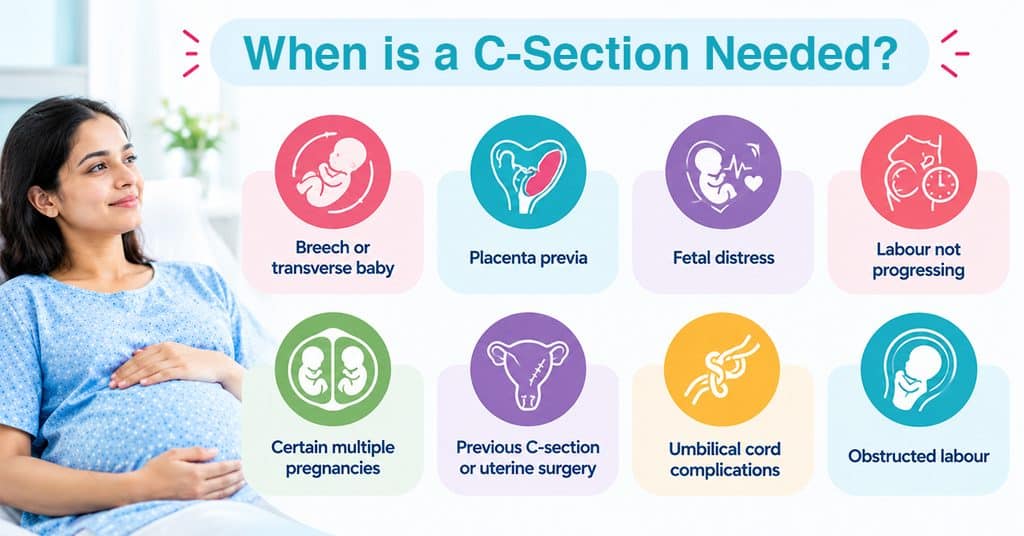
Your gynaecologists in Gurgaon usually recommend a C-section when vaginal birth could harm the mother or baby. Common reasons include:
- The baby is breech or transverse.
- Twins, triplets or more babies, depending on their position.
- Placenta Praevia – placenta is positioned over the cervix.
- Labour not progressing or fetal distress.
- Very big baby, who would not be able to come out.
- Complications with the umbilical cord, such as prolapse.
- Prior C-sections or uterine surgery, in certain cases.
- Infections, like active genital herpes.
- Obstructed labour.
If your obstetrician suggests a C-section because of any of these conditions, it does not mean you failed or had a lesser type of birth.
Can You Choose a C-Section Without a Medical Reason?
Sometimes, women choose a caesarean delivery for non-medical reasons, including a fear of pain in labour, stress, and planning. All these emotions are legitimate; do not be afraid to talk about them with your doctor.
Your doctor should warn you that surgery is not recommended without a medical necessity due to increased risks of a caesarean birth. A good doctor will explain the risks and benefits, help you with pain control, and support you during labour.
Why the Numbers Matter: C-Section Rates in India
The World Health Organisation (WHO) states that a caesarean section ratio of 10–15% and above among a population does not improve maternal or infant outcomes.
India has surpassed this range. The NFHS-5 (2019-21) shows a national caesarean rate of 21.5%, while this percentage was 17.2% in NFHS-4, and 28 out of 36 states and UTs have breached the WHO 10-15% range. The difference between hospitals is significant. While 47.4% of babies born in private hospitals were born through a caesarean section, only 14.3% were born in public hospitals.
However, this does not mean that all caesareans are unnecessary. Many save lives. What this means is that you have the right to know why you need surgery, and if you do not find the reason satisfactory, you can take a second opinion.
Can You Have a Vaginal Birth After a C-Section (VBAC)?
Yes, in many cases. Vaginal delivery following caesarean delivery (VBAC) may be possible for many women. Factors that your physician will take into consideration include:
- The nature of the incision made during previous caesarean delivery
- Previous abdominal/uterine surgeries (if any)
- Position and size of the fetus
- General well-being of the mother and the cause for the previous caesarean delivery
The major complication in vaginal delivery following caesarean delivery is rupture of the uterus along the scar line. It is relatively uncommon but serious, and requires emergency surgery. VBAC is safest when done in a facility where there is around-the-clock emergency and surgical backup available.
How to Choose the Right Childbirth Option: A Step-by-Step Guide
There is no single solution that works in all situations. These steps will help you make your choice.
Step 1: Understand Your Medical Circumstances
Your age, blood pressure, whether or not you have diabetes, previous childbirths, and the size and position of your baby are all important factors. Your gynaecologist in Gurgaon will assess these factors through antenatal checks and scans.
Step 2: Ask Your Doctor the Right Questions
Make a short list of questions before your visit:
- Is it safe for me and my baby to deliver vaginally?
- Why is a caesarean necessary if you recommend one?
- What are the risks of each approach in my specific case?
- What kind of anaesthesia is there for labour?
- What are the chances of a caesarean at your hospital, and when is it done?
- What are the consequences of an emergency caesarean?
- Is skin-to-skin contact and breastfeeding possible?
Step 3: Consider Recovery and Support
Think about who will assist you at home. A long recovery following a C-section requires additional planning, especially when there are other children and a lack of assistance. The recovery after a vaginal delivery will require assistance too.
Step 4: Plan for Future Pregnancies
If more pregnancies are in your future, consider that a C-section increases risks in future deliveries. Talk about your plans with the doctor.
Step 5: Discuss Your Concerns
If your decision to have a C-section is motivated by fear, discuss that with your healthcare provider. Antenatal classes, a birth partner, different methods of pain relief including epidural anaesthesia, and counselling can be helpful.
Step 6: Prepare for Flexibility
Labour can be difficult to predict. Birth plans are useful tools, but they are not guarantees. Should circumstances require switching from a natural birth to a C-section, flexibility of mind will help ease the process.
Step 7: Consult an Expert for Doubts
Should you be informed that you need a C-section and yet remain unconvinced, it would not be out of place to seek a second opinion from an expert in the field. Make this decision early, before labour starts.
Recovery Tips for Both Types of Delivery
Pregnancy and childbirth involve many things, and one major thing that happens is delivery. This process requires the body time to recover regardless of whether the baby is delivered via normal delivery or caesarean. There are some simple things you could do in order to speed up recovery from each type of delivery.
After a normal delivery
- Get lots of rest and drink plenty of water.
- Apply warm compresses or take a sitz bath if there are stitches or soreness.
- Begin pelvic floor exercises after your doctor’s approval.
- Fever, profuse bleeding, and discharge are warning signs to watch out for.
After a C-section
- Prop your stomach up with a pillow while coughing, laughing, and eating.
- Do not lift any heavy objects until you have been cleared by your physician.
- Keep the surgical incision clean and dry.
- Take walks after surgery according to what your doctor tells you to reduce clot formation.
- Contact your doctor if you have a fever, bleeding, or an infected surgical incision.
In any case, if you are feeling consistently sad, nervous or overwhelmed, let your physician know. Postpartum depression is fairly common but can be treated.
Conclusion
Choosing whether to have a C-section or normal delivery is not a question of which is better, but which one is safe for you and your child. Normal delivery suits most cases and is fast and effective. The C-section, on the other hand, is a great solution that saves lives whenever problems come up.
Speak up and start asking questions early enough, so that you can make your choice. The objective will always be the same – to get a healthy baby and a healthy mother. Book an appointment at one of the best hospitals in Gurgaon SilverStreak Hospital today to schedule your delivery with a team you can trust.
FAQs
In the case of a healthy and normal pregnancy of a woman, it is normal delivery that has fewer risks. In the case of a high-risk pregnancy or emergency, Caesarean would be the better option.
Both have pain but different. Painful labour occurs in the normal vaginal delivery method, while the Caesarean method has no pain due to the anaesthetic effect, but there would be a certain amount of pain during recovery.
You must allow 2-6 weeks for vaginal delivery recovery and 6-8 weeks in the case of Caesarean.
LSCS means Lower Segment Caesarean Section. This means a C-section with a low horizontal incision in the lower uterus.
Yes, you may discuss that. Usually, doctors favour vaginal delivery without any medical reasons for C-sections, but they will hear your concerns, explain potential risks and assist you.
In most cases, labour becomes faster the second time around. However, each birth is unique.
Breastfeeding is possible with a C-section. Only some assistance might be required initially due to incisional pain.