




Most back pain is not a cause for alarm and resolves within weeks. However, when there are other factors present, such as leg weakness, numbness around the groin area, loss of bladder and/or bowel control, fever, or unexpected weight loss, or it just won’t go away, then it’s time to consult a back pain expert in Gurgaon.
In today’s day and age, it is easy for a sore back to be considered common practice due to long hours spent sitting in the office or navigating through the traffic of Gurgaon.
When Should You Consult a Back Pain Specialist in Gurgaon?
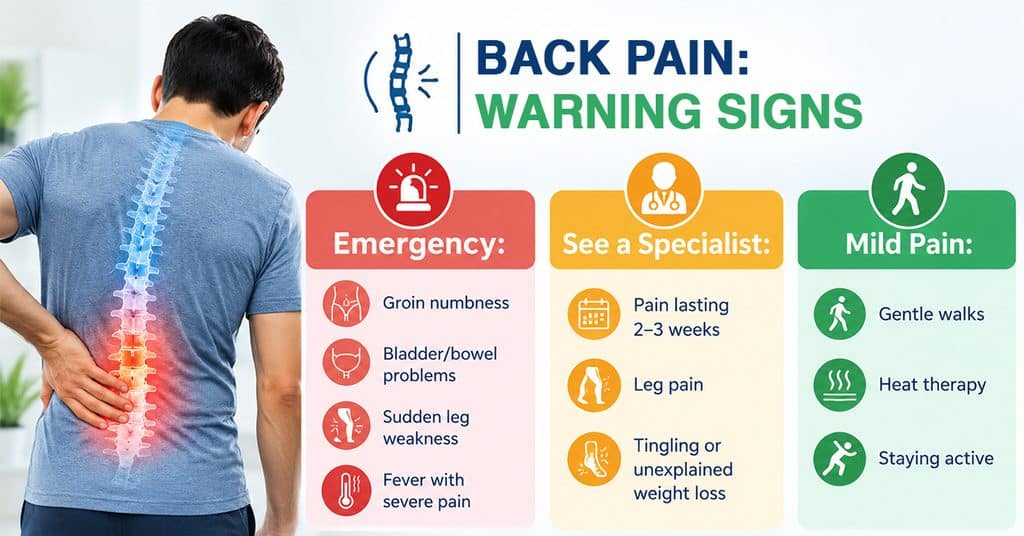
Back pain should be considered in three zones, go now, book an appointment soon, and deal with it at home.
Go to the hospital immediately
There is no need to postpone your visit if you have back pain in conjunction with the following:
- Numbness of the groin, inner thighs, and/or buttocks, also known as saddle numbness
- Problems with urination or loss of bladder or bowel control
- Suddenly feeling weakness or heaviness in one leg or both
- Sharp pain caused by a fall or road accident
- High temperature accompanied by severe back pain
Such symptoms may indicate cauda equina syndrome, spinal infection or a fracture. According to the NHS, cauda equina syndrome is a rare but severe medical condition. The affected nerves are prone to irreversible damage, and thus time is critical.
Make an appointment with a specialist within a few days
You don’t need to run to the emergency room, but you should not wait either if you have experienced:
- Chronic pain lasting for more than two or three weeks, with no visible signs of relief
- Radiating pain from your back to your leg
- Tingling, pins-and-needles sensations or numbness in your legs or feet
- Night-time pain or aggravation of symptoms when lying down
- Unexpected weight loss, or past medical history of cancer;
- Osteoporosis, chronic steroid use, or poor immune system function;
- Back pain for the first time in your life above 50 years of age.
Manage at home for now
Minor discomfort after lifting a heavy object or being seated for too long that reduces slightly daily and is not associated with leg involvement will normally be treatable at home. Move around slowly, take small walks, use a heating pad, but do not stay in bed for prolonged periods of time. Otherwise, see a doctor if no improvements are seen within two weeks.
What Are the Causes of Back Pain?

Back pain is an extremely prevalent problem. According to the World Health Organisation, low back pain affected around 619 million people globally in 2020, which was one in 13 people. This problem is the foremost reason behind global disability and is estimated to be at 843 million cases by 2050.
It is interesting that, as mentioned in the WHO fact sheet, around 90 per cent of cases do not have any structural cause visible via tests; however, there are a few categories for the causes of back pain.
Everyday mechanical reasons
This is the most common type and often the least serious type:
- Strain on your muscles and ligaments from lifting, turning and moving quickly
- Poor posture, particularly when you lean over a computer or mobile device
- Sitting for long periods without much physical activity
- Poorly developed core muscles and poor fitness level
Disc and nerve problems
The backbone has soft discs between bones to serve as cushions. However, when a disc slips, it can exert pressure on the surrounding nerve.
- Slipped/Herniated Disc
Pain in the back, pain, tingling or weakness in the leg or arm
- Sciatica
A sharp pain in the leg, running from the back, buttock, and down into the legs
- Spinal Stenosis
Spinal canal is narrowed, causing heaviness or pain in legs while walking
Wear and tear, and bone conditions
Our backbone undergoes changes as we grow older. These include:
- Degenerative disc disease and spondylosis
- Arthritis of the small joints in the spine
- Osteoporosis leading to compression fractures
- Scoliosis and spinal curvatures that place a strain on the spine
Less common but serious causes
These are rare cases, but they make the reason for raising a red flag:
- Spinal infection including spinal tuberculosis
- Tumors of the spine or the spreading of the cancer to this region
- Fracture of the spine due to trauma
- Inflammatory conditions such as ankylosing spondylitis that usually occurs in young patients with early morning stiffness and improves with movement
Why then shouldn’t you self-diagnose? Two patients may present the same symptom for entirely different reasons.
Which Back Pain Doctors Should You Consult?
Often, individuals get confused as to which specialist to visit first. The answer will depend on your symptoms and the treatment will require more than one specialist.
- Orthopedic and spine surgeons
The back pain specialists are in charge of diagnosing issues with the bones, discs and joints. They determine whether you need conservative management, minimally invasive procedure or surgery. Most patients visit them first.
- Neurosurgeons
When there is a compression of your nerves or you experience such symptoms like numbness, weakness or inability to walk, a neurosurgeon will be very helpful. They are vital for surgical procedures inside of the spinal canal.
- Physiotherapists
Physiotherapy is an essential part of your healing process. A physiotherapist helps you build your strength, increase flexibility, improve your posture and helps to prevent spine injury in the future.
Back pain interventional pain specialists
Interventional pain specialists are those medical practitioners who treat back pain by targeting its source using advanced imaging technology. Some of the procedures they perform are:
- Epidural steroids for treating pain caused by a slipped disk or sciatica
- Nerve root block to alleviate irritation in a particular nerve
- Facet joint injections to treat pain caused by small joints in the spine
Such treatments can offer relief which can help you initiate your rehabilitation process without undergoing major surgery.
How is Back Pain Diagnosed?
A good diagnosis begins with a conversation. Be prepared for questions about the duration of the problem, its location, its aggravating and alleviating factors, and your occupation and history.
Then the physician performs a physical and neurological examination. This consists of an assessment of your range of motion, muscle strength, reflexes, sensation and gait.
Diagnostic tests are only used if necessary:
- X-ray provides information on alignment, fractures and joint degeneration
- MRI visualises discs, nerves and soft tissues
- CT scan shows bone structures
- Nerve conduction study tests function of the nerve
An MRI test is not necessary for all patients with back pain. The imaging test can reveal age-related abnormalities even in asymptomatic individuals; thus, results should always be correlated with your symptoms.
What is the Best Back Pain Treatment?
The treatment of back pain depends on the causes. For the majority of people, surgical procedures are not required. The guidelines of the WHO on chronic low back pain encourage nonsurgical methods to treat chronic primary low back pain.
Treatments typically progress in stages:
Self-care and being active
Short walks, stretching, and resuming regular activity at the earliest opportunity.
Drugs
Painkillers, anti-inflammatory medicines or muscle relaxants for a limited time period, depending on a physician’s prescription.
Physical therapy and rehabilitation
Core strengthening, flexibility, and postural exercises.
Pain management techniques
Injections and nerve blocks if needed for persistent nerve pain.
Minimally invasive surgery
Procedures such as endoscopic or microdiscectomy that employ minimal skin cuts, thus ensuring quicker recovery. For suitable patients, minimally invasive spine surgery may be an option, depending on the type and severity of the disc herniation.
Complex spinal surgery
For patients who experience instability of the spine, severe nerve compression, or spinal deformities.
Surgery may be needed in case of gradual weakness in legs, problems with urination or defecation, as well as persistent pain and nerve problems with conservative management.
Back Pain Treatment at SilverStreak Hospital, Gurgaon
Are you searching for a back pain specialist in Gurgaon, India? In that case, SilverStreak Hospital should be on your list. This NABH-certified multi-speciality hospital is located in Sector 87, opposite DLF Skycourt. And this hospital has brought together spine and orthopaedic specialists, neurosurgical specialists, physical therapy experts and imaging experts.
- Collaborative care
Back problems generally do not require expertise in just one area. In SilverStreak, you will get the expertise of spine and orthopaedic specialists, neurosurgeons, pain management specialists and physiotherapists working as a team. This hospital has the expertise of senior consultants such as Dr. Vimal Gupta and Dr. Bhaskar Varma, and consultant orthopaedic & spinal surgeon Dr. Gagan Deep Yadav, who has an MCh qualification in Spine Surgery.
The importance of this collaborative effort lies in the fact that the best course of treatment is often a combination of several methods. For instance, in the case of a sciatica patient, an MRI, an injection for calming the nerve and a physiotherapy regime can be required.
- All under one roof
MRI, CT and digital x-rays are offered by SilverStreak, hence an appropriate clinical assessment can be done in combination with the imaging all within the same facility. This is a great convenience, especially when you are in pain.
- Conservative treatment first
It is the philosophy of the hospital to attempt conservative treatment methods first. Most patients receive medications, physiotherapy and postural corrections as initial treatment. The chronic joint and back pain program of the hospital offers spinal injections along with physiotherapy.
- Advanced options where required
If conservative treatments do not work, the specialists at the spine center provide advanced options such as endoscopic spine surgery and microdiscectomy, as well as spinal fusion if it is really required. The smaller incision means reduced post-operative pain and quicker resumption of a normal routine.
- Backup in case of an emergency
Since the SilverStreak clinic has all the facilities of a full-fledged hospital including ICU and emergency department, you will never be left alone if your back condition becomes acute. If you feel any alarm symptoms, you can contact the emergency service directly.
What to bring to your first visit
With the correct documents, you will not have to undergo a duplicate scanning procedure and make an additional trip, so here is what you should keep handy:
- Previous medications and records of treatment
- X-rays, MRI or CT scans results and images
- A brief note regarding the duration and location of your pain
- The list of drugs you take along with your queries
A bit of preparation will help your doctor to diagnose correctly.
How to Protect Your Back Every Day
Fix the underlying issue using treatment. Develop good habits to prevent the problem from recurring.
- Take breaks every 30 to 45 minutes by standing up, stretching, and walking for one or two minutes.
- Arrange the workspace monitor to be at eye level, with your feet firmly planted on the floor while your lower back is properly supported.
- Lift items properly. Bending the knees, keeping the load near the body, and avoiding twists.
- Core muscle strengthening through walking, swimming, and proper core muscle training protects the spine.
- Maintain ideal weight. Overweight causes constant pressure on the lower back.
- Stop smoking. Smoking is associated with poor spinal health and delayed healing of the spine.
- Proper sleep posture. Use a medium-firm mattress and proper sleeping positions.
Conclusion
Back pain is very common and usually not a problem. However, it needs treatment if it persists, spreads down to the legs, causes numbness or weakness, or comes along with fever, weight loss, or urinary or bowel dysfunction. Early treatment generally leads to easy management of the condition and quick relief.
For those looking for a back pain expert can schedule an appointment with one of the leading hospitals in gurgaon.
FAQs
When is back pain a concern?
Back pain can be serious if accompanied by loss of bladder/bowel control, numbness in the groin region, sudden leg weakness, high fever, unexplained weight loss or pain following a major trauma. Back pain that does not get better within a few weeks must be evaluated by a specialist.
Who should I visit for back pain in Gurgaon?
One should start off with an orthopaedic or spine specialist. Depending on the symptoms, one might have to visit a neurosurgeon, physiotherapist or an interventional pain specialist. This would become easier at a multispecialty hospital where all specialists are available under one roof.
Can back pain be treated without surgery?
Yes. Most of the back pain can be managed with medicines, physiotherapy, posture correction and lifestyle modifications along with pain injections whenever required.
Is an MRI needed for all instances of back pain?
No. An MRI scan is needed in cases where there is chronic back pain, when there are symptoms of nerve involvement, or when there is suspicion of a serious condition. This will be determined by your physician.
How long does it take to recover from back pain?
Back pain resulting from muscle issues tends to heal within a few weeks, depending on the type and cause of the back pain.