


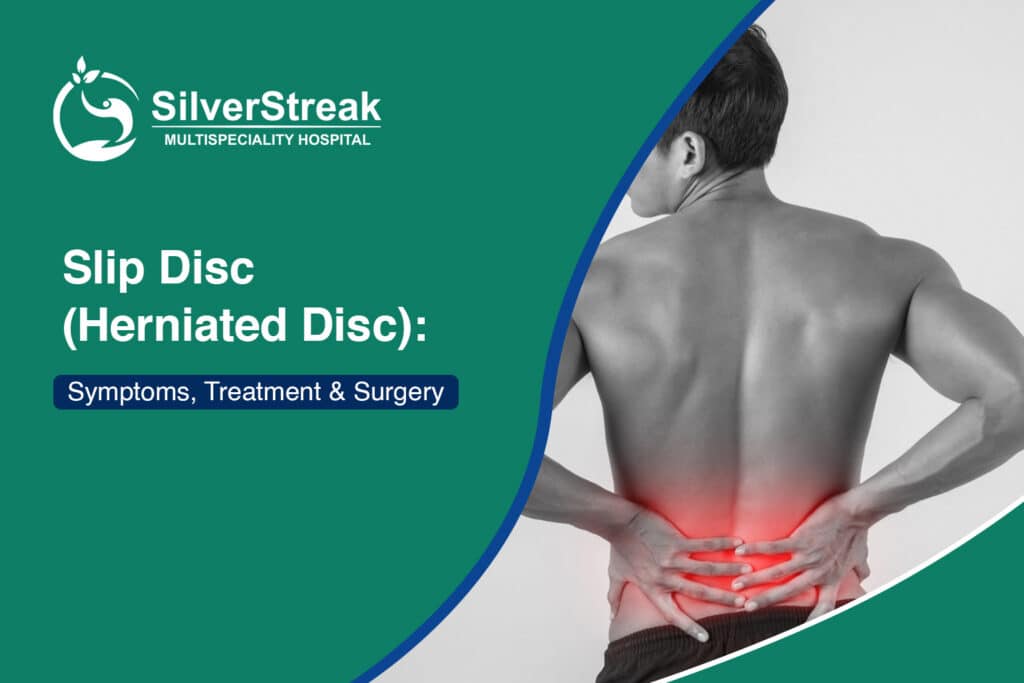
The condition of slip disc, also known as a herniated disc, occurs when the soft jelly-like material of the spinal disc leaks out from its hard outer surface. It could irritate the nerves in the vicinity, leading to neck or back pain, numbness, tingling, and even weakness in the arms or legs. Thankfully, most people respond well to conservative treatment of rest, medications, and physiotherapy.
If you are looking for slip disc treatment in Gurgaon, then this guide will tell you all you need to know about the condition.
What Is a Slip Disc (Herniated Disc)?
The human spine is made up of many small bones known as vertebrae. Between every two vertebrae is an elastic substance known as discs. A good way to visualise discs is in the context of a jam doughnut – a tough shell and a soft centre.
In the event that the outer portion breaks or splits, the soft material may protrude or leak out. This condition is known as a herniated disc. The name “slip disc” is a commonly used term; however, this is wrong. A slip disc is either bulging, ruptured or leaking.
Herniated discs occur along the spine at any level. They mainly affect the lumbar and cervical regions of the spine. They rarely occur in the thoracic region.
Bulging, Herniated and Ruptured: What’s the Difference?
These three phrases may be commonly used interchangeably, but in reality, they refer to different degrees of damage done to the disc. The primary difference lies in the amount of soft matter that has escaped and whether the outer layer of the disc has ripped.
It is useful for your physician to know where you stand to give you proper treatment, and here is an easy method to distinguish them.
- Bulging disc
The annulus protrudes but does not tear.
- Herniated disc
The annulus tears and some material protrudes through it.
- Ruptured/Extruded disc
A much bigger portion comes out and puts pressure on a nerve.
Lots of people have a bulging or herniated disc revealed in their MRI scan without experiencing any discomfort. The issue arises when it starts to irritate the nerve.
Slip Disc Causes: Why Does It Happen?
Knowing about slip disc causes will be helpful for taking measures to avoid spinal injuries. Normally, there is nothing that could lead to slipping. It all happens because the disc just wears down eventually.
1. Disc Degeneration with Ageing
Discs usually wear down with ageing. This means that they become stiffer and dry up. That is why even minor twisting and coughing may result in a tear in the disc. Most patients develop slip disc when they are from 30 till 50 years old.
2. Lifting Weight with Your Back
Lifting heavy things using your back instead of your legs is really stressful for the lower spine.
3. Prolonged Sitting
It concerns especially a person who lives in a city like Gurgaon. Sitting for a prolonged period of time creates additional pressure on the discs in the lumbar part of the spine.
4. Increased Body Weight
Increased body weight puts extra strain on the discs in your lower back, causing accelerated degeneration.
5. Smoking
Smoking decreases the amount of oxygen and nutrients available for your discs, causing dehydration at a faster rate.
6. Repetitive Actions & Injuries
Your occupation and sports activities that consist of bending, twisting or lifting increase the risk. Falling from a height or getting into an accident on the road can cause an injury.
7. Heredity
Heredity is another risk factor for developing slipped discs. If your parents ever experienced having a slipped disc, then you too could be at increased risk of it.
Symptoms of a Slip Disc
Slipped disc symptoms vary depending on the location of the disc and the nerves it affects. There are individuals who do not experience any symptoms.
Common Symptoms
- Back or neck pain that radiates to the arm, buttock or leg
- Pain that increases when one coughs, sneezes, sits or bends
- Tingling or numbness of the affected area
- Weakness of muscles, like inability to grip or lift the foot
- Burning sensation or electric shock type of pain
- Lower Back (Lumbar) Slip Disc
This is the most frequently diagnosed type. The pain usually radiates from the lower back to one side of the legs, down past the knees all the way to the feet. It is called sciatica. Numbness in the legs and/or toes can occur.
- Neck (Cervical) Slip Disc
The neck or upper back pain can travel through the shoulders to the arms and fingers. Some people have weakness of grip and tingling sensations in the hands.
When Is It an Emergency?
Consult your doctor right away when you experience any of the following:
- Inability to control urination or defecation
- Numbness in the area between the legs or the inner thighs (saddle anaesthesia)
- Suddenly decreasing muscle strength in the legs
- Sharp pain after an injury
All these might suggest that you are suffering from cauda equina syndrome.
When Should You See a Spine Specialist?
Back pain is widespread, and most cases tend to heal on their own. However, make an appointment if:
- The pain persists for more than a week or two
- The pain tends to radiate down your arm or leg
- Numbness, tingling, or weakness
- The pain wakes you up at night or interferes with your daily activities
- Early detection usually results in easier treatment.
If you experience persistent back pain, numbness, tingling, or weakness, consult an orthopaedic doctor in Gurgaon for a proper evaluation and treatment plan.
How Is a Slip Disc Diagnosed?
The specialist will normally start by asking you to explain your history and then examine you. The examination consists of checking your posture, reflexes, muscle power, sensation, and mobility. There are some simple leg raise tests that can be done to detect nerve irritation.
Further investigations, if required, may involve the following:
- MRI is the investigation of choice for viewing the disc and nerves.
- CT scan is required if an MRI is not possible.
- X-ray reveals the bone structure but not the disc.
- Nerve conduction studies/EMG are used to investigate nerve function.
Investigations are always interpreted in the context of your symptoms. Depending on your symptoms, your doctor may recommend an MRI scan in Gurgaon to assess the spinal discs and identify possible nerve compression.
Slip Disc Treatment: Non-Surgical Options
However, there is good news. As per the popular medical guidelines, most individuals with a herniated disc recover without undergoing any surgery in a period ranging from a few weeks to a few months.
1. Short Rest and Staying Active
If you are in intense pain, then take rest for one or two days. Thereafter, moving around a short distance is better than remaining in bed. Remaining in bed for a long time can lead to stiffness in the back.
2. Medication
Some medications which your physician might prescribe include:
- Analgesics and anti-inflammatory drugs
- Muscle relaxants in case of spasms
- Medications for nerve pain
Please refrain from self-medication for long durations.
3. Physiotherapy
Physiotherapy forms the crux of recovery from a slipped disc. The role of a qualified physiotherapist is to provide the patient with the appropriate exercises to improve their core strength and posture, along with reducing the stress on the nerve. A personalised rehabilitation plan and guided physiotherapy in Gurgaon can help improve mobility, strengthen supporting muscles, and support recovery from a slipped disc.
4. Ice and Heat Therapy
Icing therapy is used to reduce inflammation in the early stages of injury, while heat therapy is useful for relaxing muscles.
5. Epidural Steroid Injections
In case of severe pain and when no improvement is seen, a steroid injection near the affected nerve can help decrease the swelling and provide pain relief. This procedure is done using imaging guidance. It does not correct the disc problem, but it provides you with a pain-free period to perform your physiotherapy.
6. Lifestyle Modifications
- Keep your body weight within normal limits
- Stop smoking
- Do not sit continuously for more than 30 to 45 minutes
- Use a firm mattress while sleeping and place a pillow between your legs if you sleep on your side
Slip Disc Surgery: When Is It Needed?
Surgery to fix the problem of a disc slipping is not the first resort; it is considered when:
Symptoms have not been relieved after 6-12 weeks of appropriate conservative treatment.
- Worsening of symptoms like leg/arm weakness is noted.
- If pain is so severe that it starts interfering with daily activities.
- Presence of cauda equina syndrome.
This indicates a rare condition; less than 1% of people having slipped discs undergo surgery. The right patient will benefit greatly from it.
Types of Slip Disc Surgery
Disc surgery is often recommended when conservative management, such as rest, medication, and physiotherapy, fails to relieve pain or in cases where there is a nerve injury causing weakness and numbness. The procedure will depend on the site of the herniated disc and its severity.
- Microdiscectomy (Microscopic Discectomy)
It is the most frequently used surgical procedure for a lumbar herniated disc. Through an incision in the back, the surgeon utilises a microscope or magnification device and removes the portion of the disc that is impinging on the nerve.
- Endoscopic Discectomy
A minimally invasive procedure in which a slim tube with a video camera is used. The incision is small, there is little damage to muscles, and many people leave the hospital on the same day or the next day.
- Laminectomy or Laminotomy
The removal of a portion of the bone (lamina) creates room for the nerve. This procedure is helpful where the spinal canal is narrow in addition to the disc.
- Spinal Fusion
In some cases, when the spine is unstable, the fusion surgery involves joining two vertebrae via screws, rods or cages. In this case, spinal fusion is not a standard treatment for a simple slipped disc but is needed in certain conditions.
- Artificial Disc Replacement Surgery
For some patients who have neck problems, the damaged disc can be replaced with an artificial one to retain their mobility. It may not be possible for everyone, though.
What Are the Risks?
Just like any surgical procedure, there is always risk involved with spinal surgery, including the risk of infection, haemorrhage, nerve damage, or even re-herniation of the disc. This risk is minimised by an experienced team and state-of-the-art procedures.
Recovery After Slip Disc Surgery
First days: walking is recommended soon after the operation, even on the very same day in some cases.
First 2-6 weeks: some physical activity without lifting anything heavy, along with physiotherapy, is advised.
After 6-12 weeks: usually people go back to work at their desk.
After 3 months: recovery continues with rebuilding strength and fitness.
All patients are different in recovery, which is why you have to follow the advice of your surgeon.
Slip Disc Treatment in Gurgaon: Why Choose Silverstreak Hospital?
Selecting the right facility to be treated is as important as selecting the right treatment itself. For those seeking slip disc treatment in Gurgaon, there is the facility of Silverstreak Hospital that provides patient-centric spine treatments, based on a philosophy – operate only when necessary.
This is how it works for the patients.
- A Step-by-Step, Honest Approach
Silverstreak Hospital‘s treatment plan starts with a thorough assessment of your symptoms, history and imaging. If your slipped disc can be treated without surgery, using drugs, physical therapy, and lifestyle changes, then that is what you will be advised to do. Surgery is considered only when it is really necessary.
- Experienced Orthopaedic and Spine Care
Your treatment is devised by experts who deal with spinal issues on a regular basis. They understandably explain your MRI and answer all your questions.
- Minimally Invasive Options
In the case that slip disc surgery becomes required, the aim will be on minimally invasive methods where possible. Small cuts usually equate to less pain, less blood loss, a shorter hospital stay, and a faster return to normal life.
- One-Stop Service for All Your Needs
From diagnosis to imaging, injections, surgery, and physiotherapy, you do not need to go here and there. We provide a team of specialists who will work together from your first appointment to your recovery.
- Physiotherapy and Follow-Up
Surgery requires proper rehabilitation. Guidance in physiotherapy, posture and follow-ups will aid your recovery process and reduce the risk of recurrence.
Convenient for Gurgaon and Nearby Areas
Wherever you are living in Gurgaon, Delhi NCR or surroundings, having good spine care nearby makes it much easier for you to have your appointments and recoveries stress free.
Feeling pain in your back or legs which is persistent? Get an appointment at Silverstreak Hospital, Gurgaon, and get your spine examined today.
How to Prevent a Slip Disc
Age and genetics are factors that you cannot control, but you can keep your spinal discs safe by adopting simple measures:
- Exercise regularly- get up and stretch after every 30-45 minutes.
- Condition your core- having strong abdominal muscles will provide stability to the spine.
- Lift the right way- use your leg muscles while keeping the lifted object close to your body.
- Create a proper working environment- position your computer at eye level.
- Maintain optimal body weight.
- Stop smoking.
- Work out frequently- walking, swimming, and yoga are good options for your spine.
Conclusion
A slipped disc can be alarming when it leads to pain in the legs, but remember that most cases can be treated effectively without any surgery. All it takes is proper care and attention towards the condition.
In case of back or neck pain, weakness and numbness, don’t hesitate to consult a doctor. If you are searching for reliable slip disc treatment in Gurgaon, then our specialists at Silverstreak Hospital are there to help you.
FAQs
In many cases, yes. The body absorbs whatever has been released from the spine, as well as the irritation of nerves. It takes between weeks and months, and medication will ensure that you get through it.
A patient usually recovers within six to twelve weeks. Post-surgery, many patients are able to go back to desk jobs in a few weeks, but recovery may take several months.
It can actually be beneficial. One needs to discontinue walking if it aggravates leg pain and numbness.
Modern techniques like microdiscectomy and endoscopic surgery are considered safe if performed by experienced doctors on suitable patients. Your doctor will explain your personal risk factors.
Yes, it is possible, but especially if posture and lifestyle are not changed. Proper exercise, maintaining a healthy weight, and proper lifting lower the chances of recurrence.
Consult an orthopaedic spine surgeon or neurosurgeon. Your family doctor will also advise you accordingly.