

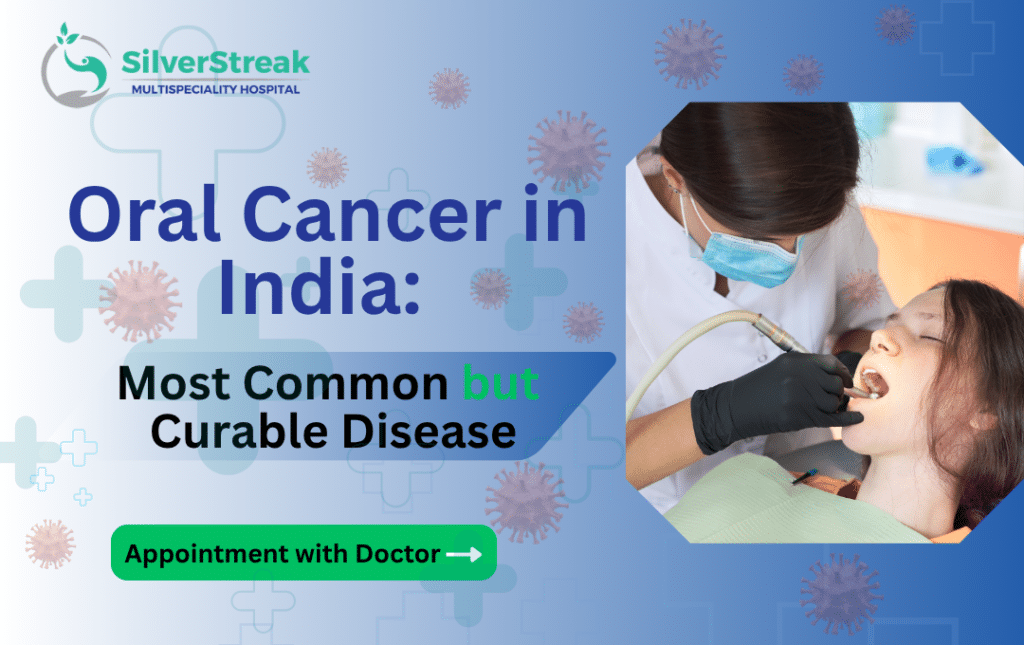
An alarming rate of oral cancer incidences is impacting the public health of India. In India, it accounts for 40% of all types of cancer. The most surprising fact is: 5+ people in India die every hour due to oral cancer. So, it indicates that oral cancer in India becomes fatal. Though this disease is common among people over 40 years of age, younger persons are also suffering from it now.
But the good news is that early detection of oral cancer is treatable, and it is preventable too. Therefore, if you feel any soreness, lump, or tenderness on your lips, inside the mouth, or in the throat, book a doctor’s appointment immediately. In this blog, you can learn the symptoms, stages, treatment expenses, and survival rate of oral cancer in India:
What is Oral Cancer & Why India Is Affected?
Cancer refers to the unmanageable division of cells that attack and damage surrounding tissue. Oral cancer, particularly, develops in the lips, tongue, cheeks, floor of the mouth, hard and soft palate, sinuses, and pharynx (throat).
It starts as a painless white or red patch, lump, or ulcer that doesn’t heal and can spread to other areas of the head and neck. Unfortunately, delayed detection of oral cancer can be life-threatening. The main types of oral cancers are:
| Squamous cell carcinoma | It originates in the squamous cells lining the lips, tongue, gums, inner cheeks, roof or floor of the mouth, and throat. This is the most common oral cancer in India. |
| Verrucous carcinoma | It is a less common subtype of squamous cell carcinoma. Verrucous carcinoma has a tendency to develop gradually. It may exist as a wart-like lesion in the mouth. |
| Adenocarcinoma | It begins to grow in the salivary glands or glandular tissues of the throat within the mouth. |
| Mucoepidermoid carcinoma | This is another type of salivary gland cancer. It can develop in the minor salivary glands present throughout the mouth and throat. |
| Sarcomas | Sarcomas are rare cancers. It originates in the muscles, bones, or connective tissues of the mouth and throat. |
| Lymphomas | Lymphomas grow in the lymphatic system and can often involve the tissues of the mouth and throat. |
| Melanomas | These cancers develop from melanocytes, the pigment-producing cells. It can occur in the oral mucosa or on the lips. |
Causes of Oral Cancer Prevalence in India
There are many underlying reasons that can enhance the likelihood of oral cancer cases in India. Though most of the causes are inevitable, lifestyle changes can control the spread of this dreadful disease. Read to know what can increase the risk of oral cancer in India:
● Tobacco & alcohol consumption
● Gutka, pan masala, & betel nut abuses
● Decreased immune system
● Family history of oral cancer
● Prolonged & extreme exposure to sunlight
● Low-quality diet
● HPV viruses
● Age factor
Above all, low awareness and late diagnosis are the two main causes that enhance the risk of oral cancer prevalence in Indians. According to a study, in India, nearly 60,000 new cases of oral cancer are reported each year. In 2022, India ranked second based on the incidence, mortality, and prevalence of oral cancer.
Oral Cancer Symptoms
Patients may ignore oral cancer symptoms as normal health complications. Instead of self-diagnosis and relying on over-the-counter medications, you should consult a specialist. Therefore, you need to know the symptoms of oral cancer for awareness:
Early Symptoms
Consider the following symptoms you are experiencing for 2-3 weeks:
● White or red patches inside the mouth or oral cavity
● Persistent & non-healing sores or ulcers in the mouth (>3 weeks)
● Regular & unexplained bleeding in the mouth or gums without any particular reason
● Tenderness, pain, or numbness in the tongue or lips
Advanced Symptoms
Neglecting the early oral cancer symptoms can result in these advanced ones:
● Difficulty chewing or swallowing, if accompanied with pain
● Persistent ear pain
● Loose teeth without a dental cause
● Visible lump in the neck or thickening inside the mouth, tongue, or neck when touching them
In addition to all of these symptoms, you may encounter voice changes or hoarseness in voice for more than 2 weeks, unexpected weight loss, feeling something stuck or swelling in the neck, etc. Most importantly, oral cancer is often painless in the early stages. But you should not wait for pain to visit a doctor.
Oral Cancer Stages: From Stage 1 to Stage 4 Explained
| Stage | Tumor Size | Spread | Key Meaning |
| Stage 0 | None | None | Cancer cells are present only in their original place |
| Stage I | < 2 cm | None | Localized, highly treatable |
| Stage II | 2–4 cm | None | Still contained |
| Stage III | > 4 cm | Nearby lymph nodes | Moderate spread |
| Stage IV | Any size | Distant organs | Advanced, complex treatment |
Stage 0 (Carcinoma in situ): Cancer cells exist only in the exterior layer of cells lining the oral cavity. They have not captured deeper tissues.
Stage I: In this stage, the tumor is small (< 2 cm). It is limited to only the oral cavity, not spreading to adjacent lymph nodes or distant sites.
Stage II: The tumor becomes larger (2-4 cm) in this stage. It has spread to the nearby tissues. But it has not spread to the lymph nodes or outlying locations.
Stage III: During this stage, the tumor is larger (> 4 cm). It may have extended to proximate tissues or lymph nodes.
Stage IV (Metastatic): This stage is classified into 3 parts: stages IVA, IVB, and IVC.
In stage IVA, the tumor has spread to adjacent tissues, lymph nodes, or both. But it has not spread to faraway sites.
During stage IVB, the tumor has spread to nearby tissues, lymph nodes, or both. It may have extended to distant sites.
In stage IVC, the tumor has spread to distant organs or distant lymph nodes.
Depending on the oral cancer stages, doctors decide on their treatment procedures that may vary according to the patients’ overall health conditions and treatment preferences.
Oral Cancer Survival Rate by Age — What Data Tells Us
| Stage at Diagnosis | 5-Year Survival Rate |
| Stage I | ~80–90% |
| Stage II | ~60–70% |
| Stage III | ~40–50% |
| Stage IV | ~20–30% |
According to the above table, the oral cancer survival rate may decrease based on the stage the patient is fighting against the disease. So, early detection can save many lives that are dealing with oral cancer in India. Recognizing the symptoms of oral cancer and a prompt visit to a specialist doctor can enhance its survival rate. Thus, patients can get more treatment options to cure themselves or improve their present conditions.
Apart from early screening and diagnosis, age is another big factor for survival. Approximately 20% of people who have oral cancer are younger than 55 years. A study shows that around 31% of new cases of oral cancer are found in the age group of 55-64. On the other hand, the mortality rate due to this cancer is high in people aged between 65 and 74.
However, your lifestyle and diets can prevent you from oral cancer and increase your survival rate. If your overall health conditions are good enough, you can easily respond to the treatment procedures and recover fast.
Besides, selecting the right treatment option at the right time can help patients survive for more years. Moreover, developing our lifestyle choices, such as quitting smoking or alcohol consumption, can be helpful for the patients living with oral cancer and its prevention.
Oral Cancer Treatment Cost in India
Oral cancer treatment costs may vary depending on some factors, such as the stage of oral cancer the patient is struggling with, the patient’s residential city, and the hospital tier. Understanding these factors, you can plan your healthcare requirements.
Some other factors like hospital type, whether it is private or public hospital, city tiers or geographical locations, medical professionals’ fees, diagnostic requirements, timing
(same-day or emergency procedures), facility standards in hospitals & diagnostic centers, post-treatment care, and more. Patient-specific factors may add up to the oral cancer treatment cost.
According to the individual’s health conditions, doctors recommend personalized treatment plans. In this case, having healthcare insurance coverage can help patients with treatment and hospitalization. Though you have a health insurance scheme, you need to know its terms and conditions, especially what type of oral cancer treatments are covered by the scheme along with its waiting period for claim redressal.
Cost by Treatment Type
Considering all of these responsible factors, you may assume the total expenses of oral cancer treatments in India. Here is an at-a-glance table for cost by treatment type:
| Treatment | Approximate cost in India |
| Surgery | ₹150,000 – ₹400,000 |
| Radiation Therapy | ₹150,000 – ₹300,000 |
| Chemotherapy | ₹50,000 – ₹200,000 |
| Combined (Stage III/IV) | ₹400,000 – ₹800,000+ |
SilverStreak Hospital provides affordable and transparent oral cancer treatment in Gurgaon. Request a personalised treatment cost estimate or speak to our team today.
When Should You See a Doctor?
There are some warning signs for oral cancer’s presence in your body that require an urgent doctor visit. You need to identify them as soon as possible to get timely treatment. Let’s have a look at this self-checklist:
1. If you experience any white/red patch inside your mouth and if it is persistent for 2 weeks
2. Having mouth ulcer and not healing in 3 weeks
3. Developing lump or feeling thickening inside your mouth
4. Facing difficulty in opening mouth fully
5. Encountering sudden weight loss along with unbearable mouth pain
Whether you notice any of these symptoms, you must book an appointment with an oral cancer specialist doctor. Tobacco uses can make people vulnerable to oral cancer. So, for tobacco users: it is a must to do this monthly self-checkup to receive timely treatment and increase survival rates. Book a free oral cancer screening at SilverStreak Hospital and start your recovery journey at the earliest.
How SilverStreak Hospital Treats Oral Cancer
We, at SilverStreak Hospital, use advanced imaging and radiation technologies while treating oral cancer patients. Our multidisciplinary team has a renowned oncologist, Dr. Manish Kumar, with 20+ years of experience. Specialized in head and neck surgeries, he has a keen interest in oral cancer. Most importantly, he uses a transparent and ethical treatment approach while serving his patients. His patient-centric treatment procedure brings satisfaction to every patient.
We aim to provide safety, precision, and compassion in every stage of the cancer treatment. Our specialist ensures speedy recovery with the aid of upgraded operational techniques. SilverStreak Hospital, accredited with NABH/JCI, offers state-of-the-art facilities for pre- and post-surgical care and support. Above all, our personalized treatment plans are accompanied by chemotherapy and radiation specialists to deliver the best possible outcomes.
Book a consultation with our oral cancer specialist.
Conclusion
Early detection of oral cancer not only increases the overall survival rate of patients but also enhances their quality of life. Therefore, timely diagnosis and the right treatment can be life-saving in oral cancer. In addition, ‘prevention is better than cure.’ Following this, individuals should quit excessive smoking, limit alcohol consumption, maintain a healthy diet, practice good oral hygiene, and schedule routine health check-ups.
If you or someone you know experiences any signs of oral cancer’s existence, make an appointment with a doctor without any delay. At SilverStreak Hospital, we offer advanced diagnosis procedures and treatment options for oral cancer in India. Contact us for a free screening and doctor’s appointment.
FAQs
The early signs of oral cancer are persistent mouth sores or ulcers for two weeks, unusual white or red patches on the tongue, gums, or inside the mouth, and unexplained lumps or thickening. Also, patients with oral cancer can experience painful swallowing or unexplained bleeding inside their mouth.
Yes, oral cancer is highly curable if caught early. Oral cancer has 5-year survival rates nearly 85%–95% when treated in its initial stages. Early detection allows for less aggressive, highly effective treatment, such as minor surgery, and prevents the cancer from spreading.
Oral cancer treatment in India ranges from ₹95,000 to over ₹1,000,000 ($1,150–$12,000+). It has an average cost of roughly ₹200,000–₹500,000.
Generally, the 5-year relative survival rate for stage 4 oral cancer is between 30% and 40%.
Oral cancer presents as a persistent, non-healing ulcer, lump, or red/white patch that lasts longer than two to three weeks. Sometimes, it has no pain at all. It becomes painful while progressing. On the other hand, normal mouth ulcers are painful, flat, and heal on their own within one to two weeks.